
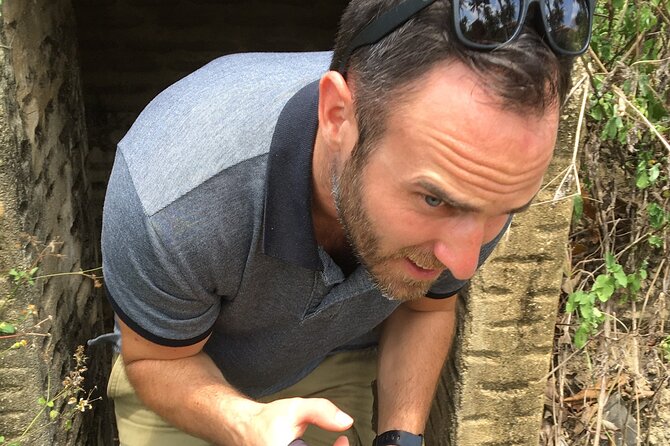
Reviewed · HOI AN TOURS
WAR TOUR to MY LAI MASSACRE & KY ANH TUNNELS & GOLDEN PAGODA
My Lai is not a casual sightseeing stop. It is a quiet memorial to one of the Vietnam War’s worst atrocities, and this tour puts that difficult history at the center of a full day through central Vietnam. You’ll also visit the Ky Anh Tunnels, the former Chu Lai Air Base area, and Chùa Minh Đức’s enormous Quan Am statue.
I like the private format, since your group can move at its own pace and ask direct questions. I also like the range of places covered, from a memorial and museum to wartime tunnels and a major Buddhist site. The main drawback is the long, serious nature of the day: this is best for people ready to think carefully about war, not for anyone seeking a light excursion.
Key points to know before booking
- My Lai is the emotional center: You watch a short documentary, then visit the museum and memorial village connected to the 1968 massacre.
- Vincent is the named guide: He leads the day with strong knowledge of the war and a clear concern for the Vietnamese people who suffered through it.
- Ky Anh gives you a physical sense of wartime life: You visit tunnels built and used by the Viet Cong, with local insight connected to their construction.
- The tour is private: Only your group takes part, which makes a difficult subject easier to discuss openly.
- Chùa Minh Đức adds a striking cultural contrast: The Golden Pagoda is home to Southeast Asia’s tallest Quan Am statue.
- The tour is not about Kim Phuc: If you are looking for the story of the famous Napalm Girl photograph, this is the wrong excursion.
My Lai puts the human cost first
The day begins with hotel pickup in Hoi An at 8:15 a.m. From there, the road leads south toward My Lai Village in Quang Ngai Province. The journey takes you away from Hoi An’s old-town lanes and into an area tied directly to the war, rather than to the usual sightseeing circuit.
At My Lai, you first watch a 20-minute documentary about the tragedy. That is a useful introduction before entering the museum and memorial area. The film gives you a basic timeline and prepares you for the names, photographs, and accounts that follow.
The visit lasts about 1 hour and 30 minutes, with admission included. You’ll see the site connected to the My Lai Massacre, which took place in 1968 during the Vietnam War. The subject is painful, and the presentation is intended to make you think about civilians, military orders, and the consequences of violence rather than turn the event into a battlefield spectacle.
I appreciate that the visit is given enough time. A rushed stop would reduce My Lai to a grim photo opportunity. Here, the documentary, museum, and memorial village form one connected lesson. You can take in the setting, listen to the guide, and consider what happened without having to hurry through in a few minutes.
This is also where Vincent’s role matters most. His task is not simply to point out buildings or repeat dates. He explains the wider war and the suffering Vietnamese people endured, helping connect the location to the larger conflict. The strongest praise for the tour centers on his passionate, engaged approach, so you should expect the guiding to be a major part of the experience.
You should also know what this tour does not cover. It is not a Kim Phuc, or Napalm Girl, tour. The focus is My Lai, the Chu Lai military base area, and Viet Cong tunnels. That distinction is important because visitors sometimes connect every Vietnam War excursion with the famous photograph taken near Trang Bang. This tour follows a different story and a different part of the war.
A few other Hoi An trips to compare
- Hoi An: Basket Boat Ride in the Coconut Forest
★ 4.9 · 4,956 reviews - Hoi An: Vietnamese Coffee Culture and Coffee Making Class
★ 4.9 · 4,006 reviews - Hoi An: Vietnamese Foldable Lantern Making Class
★ 4.9 · 3,742 reviews
Chùa Minh Đức changes the mood
After My Lai, the tour visits Chùa Minh Đức, also called the Golden Pagoda, for about one hour. The temple is in Quang Ngai Province and is being developed as a major local landmark.
The main sight is the huge Quan Am statue, described as the tallest Quan Am statue in Southeast Asia. Quan Am is a Buddhist figure associated with compassion, and the statue gives this stop a very different mood from the morning’s memorial visit.
I like this contrast. The temple does not erase or soften the difficult history you have just faced, but it gives the day a cultural and spiritual pause. After an emotionally heavy memorial, a large Buddhist site can help you slow down and absorb the day.
The name Golden Pagoda may suggest a compact shrine, but the description points to a large-scale site with a landmark statue. Allow about an hour, and expect this to be a visual stop as much as a historical one. The information provided does not promise a formal religious ceremony or a particular set of temple activities, so the value here is the setting, the statue, and the chance to see an important contemporary Buddhist site in the province.
Because the tour is private, you can ask Vincent how this site fits into the region’s culture and how it differs from the war memorials. That conversation is one reason the private format works well. You are not confined to a fixed script for a large bus group.
Ky Anh Tunnels make the war physical
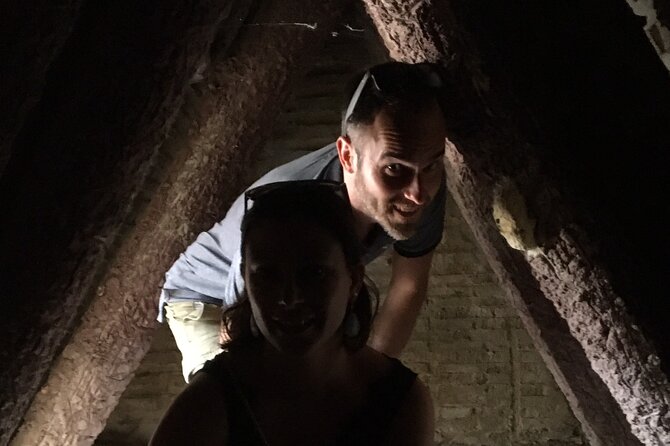
The next major stop is Ky Anh Tunnel, with about 1 hour and 10 minutes set aside for the visit. The tunnels are in the rural countryside of Quang Nam Province and were built and used by the Viet Cong during the war.
Unlike a museum display, a tunnel site gives you a physical way to consider how the conflict was fought. You are looking at spaces connected with concealment, movement, and survival. The description presents the visit as a chance to walk where wartime history took place, though exact tunnel dimensions and accessibility details are not provided.
One especially distinctive element is the local connection to the tunnel’s construction. The guide can introduce you to the builder, making the site feel less abstract. That personal link matters. Instead of viewing the tunnels as an anonymous military relic, you get a connection to the people who made and used them.
You should allow room for this stop to be reflective rather than entertaining. The tunnels are not presented as an amusement attraction. Their value lies in helping you picture the difficult conditions behind the conflict and the work required to create these underground routes.
The rural setting also broadens the tour. My Lai centers on a massacre and its victims. Ky Anh shows another side of the war, the underground systems used by Viet Cong forces. Together, the stops provide a fuller picture than a single memorial visit could offer.
The tour summary refers to Ky Anh in connection with the Tet Offensive of 1968 and the fighting between American forces and the Viet Cong. That context gives the visit more weight. You are not just seeing an old tunnel. You are learning how military campaigns affected villages and countryside far from the polished tourist centers.
Since no detailed terrain or tunnel measurements are supplied, I would ask the operator about the physical conditions if you have mobility concerns. The general information says most people can participate, and service animals are allowed, but it does not promise that every section of the tunnel route is suitable for every ability.
Nui Thanh and the Chu Lai Air Base connection
The final listed stop is Nui Thanh, with about 20 minutes allocated. This is connected to Chu Lai Air Base, a military airport built and operated by the United States Marine Corps from 1965 to 1970.
The stop is free, and the short time tells you how to view it: this is a brief historical pause, not a full museum visit. The area helps connect the tour’s stories of villages and tunnels with the American military presence in the region.
Chu Lai Air Base was near Tam Ky, the largest city in the former Quang Tin Province. That information gives you a sense of the base’s place in the wartime network, but the tour details do not list surviving buildings, exhibits, or a formal visitor center. Keep your expectations practical. You are stopping to understand the location and its role, not to tour a preserved American airfield complex.
I like the inclusion of this short stop because it prevents the day from presenting only one side of the conflict. My Lai brings attention to civilian suffering, and Ky Anh explains Viet Cong activity. Nui Thanh adds the American military infrastructure that shaped the region.
At the same time, the 20-minute visit may feel brief if aviation or military engineering is your main interest. If you want a detailed account of the base, ask Vincent questions during the stop or on the drive. The private setting gives you a better chance to follow up than a large scheduled group would.
Same base, a completely different day:
- Cooking Class Hoi An:Local Market, Basket Boat, Fishing & Cooking
★ 5.0 · 3,660 reviews - Hoi An Cooking Class(Market,BasketBoat Crabfishing&Cooking Class)
★ 5.0 · 3,386 reviews - Hoi An: My Son Sanctuary Early Morning w. Champa Food Brunch
★ 4.9 · 2,750 reviews - Hoi An/ Da Nang – Ba Na Hills – Golden Bridge Deluxe Small group
★ 5.0 · 2,613 reviews
What the private format means for you
This is a private tour, so only your group participates. That is a real advantage for a subject as sensitive as My Lai. You can ask a difficult question without speaking over a crowd, and Vincent can spend more time on the parts that matter most to you.
The tour provider is Hoi An Cham Cham Travel. Vincent is the guide named in the strongest comments about the experience, and his style is described as engaging, passionate, and well informed. The information also emphasizes professional guiding, communication, and willingness to accommodate requests.
You should still keep your expectations realistic. A private tour does not mean the day will be leisurely. Four major stops are packed into roughly 8 to 9 hours, beginning at 8:15 a.m. and ending back at the Hoi An meeting point. The exact return time is not stated, so plan your evening with some flexibility.
The mobile ticket is convenient, and confirmation is provided at booking. The meeting point is in Hoi An, Quang Nam, Vietnam, with the activity returning to that same meeting point. The tour is also listed as being near public transportation, though hotel pickup is part of the morning plan.
No meal is specified, so do not assume lunch is included. The supplied details also do not list vehicle type, exact group size beyond the private arrangement, or specific refreshment stops. Those omissions do not make the tour poor value, but they are sensible points to clarify before departure.
Is $94 a fair price?
At $94 per person, this is not the cheapest day trip from Hoi An. The value depends on what you want from a tour.
You are paying for a full day with a private group, transport from Hoi An, an English-speaking history-led experience with Vincent, and admission to My Lai, Chùa Minh Đức, and Ky Anh Tunnel. The mix of sites would be difficult to understand fully if you simply visited them without context, especially My Lai and the tunnel system.
The price makes more sense if you care about interpretation rather than just transport. A driver who drops you at the sites would not provide the same connection between the massacre, the Viet Cong tunnels, and the former American air base. Here, the guide is a central part of what you are buying.
The value is also stronger for small groups. If two or three people share the private outing, the cost buys privacy, direct discussion, and a carefully focused day. Solo visitors may find the price harder to justify, though the tour’s subject matter and range of stops may still make it worthwhile.
The five or more recent bookings suggest continued interest, but the clearest measure is your own travel style. If you want a serious war-history day and prefer a private guide, $94 is reasonable. If you want relaxed scenery, food stops, or a short outing, it is not the right use of your budget.
Who should book this day?
I would recommend this tour to you if you want to understand the Vietnam War through places connected to actual events. It suits history students, people interested in military history, and anyone who wants to look beyond Hoi An’s old town and beach resorts.
It is also a strong choice if you prefer a guide who can explain events in context. Vincent’s approach is especially useful at My Lai, where a short visit without explanation could leave you with only a disturbing impression and few answers.
You should be prepared for difficult material. My Lai is a massacre memorial, not a cheerful attraction. The tour asks for attention and respect, and it may leave you thinking about the day long after you return to Hoi An.
I would not choose it if your main goal is the Kim Phuc story, because that is not covered. I would also hesitate if you want a flexible day with plenty of free time. The schedule is full, and the long drive between Hoi An and the sites forms a large part of the outing.
The weather policy offers some reassurance. If poor weather forces cancellation, you can take a different date or receive a full refund. You can cancel for a full refund up to 24 hours before the start time. Cancellations or changes made within 24 hours are not refunded or accepted.
My call: book it for a serious history day
I would book this tour if My Lai is important to you and you want more than a quick memorial visit. The combination of My Lai, Ky Anh Tunnels, Chu Lai, and Chùa Minh Đức gives you four different ways to read the region: civilian suffering, underground resistance, American military power, and Buddhist culture.
The strongest reason to go is the guide. Vincent’s passion and ability to explain the war appear to be central to the experience, and the private setting gives you space to ask questions. The main caution is emotional and practical: this is a long, heavy day with no listed meal stop, and the tour does not cover Kim Phuc.
Book it for honest history, difficult reflection, and a guide-led look at places far from the standard Hoi An route. Skip it if you want easy entertainment or a relaxed sightseeing loop.
FAQ
How long does the tour last?
The tour lasts approximately 8 to 9 hours.
What time does the tour begin?
Hotel pickup begins at 8:15 a.m.
Where does the tour start and finish?
It starts in Hoi An, Quang Nam, Vietnam, and ends back at the meeting point.
Is this a private tour?
Yes. Only your group participates in the activity.
Is admission included at the main sites?
Admission is included at My Lai, Chùa Minh Đức, and Ky Anh Tunnel. The Nui Thanh stop is listed as free.
Does the tour visit Kim Phuc, the Napalm Girl site?
No. The tour focuses on the My Lai Massacre, Chu Lai Air Base, and Viet Cong tunnels. It does not cover Kim Phuc.
Can I cancel for a full refund?
Yes. You can cancel at least 24 hours before the start time for a full refund. Cancellations within 24 hours are not refunded.
What happens if bad weather cancels the tour?
You can choose a different date or receive a full refund if the experience is canceled because of poor weather.
Newly listed around Hoi An
- VIP Limousine: Hoi An to Hue Trip★ 4.0 · 39 reviews
- Hoi An Ancient Town And Countryside Tour Full Day★ 5.0 · 39 reviews
- A Private Full Day Tour to My Son Sanctuary & Marble Moutains★ 5.0 · 39 reviews
- Hoi An: Private Car To/From Hue via Multi Attraction( 1-Way)★ 5.0 · 39 reviews
- My Son Sanctuary and Hoi An Walking Tour★ 4.5 · 40 reviews
- From Hoi An: Cooking Class at Organic Farm★ 5.0 · 40 reviews
- Coconut Boat Hoi An★ 4.6 · 41 reviews
- Hoi An: Full-Day Small Group Trip to My Son Sanctuary★ 4.4 · 41 reviews
Hoi An Tours, compared.

Vietnamese Coffee Culture and Coffee Making Class
Read our review →

Cooking Class Hoi An:Local Market, Basket Boat, Fishing & Cooking
Read our review →
Hoi An Cooking Class(Market,BasketBoat Crabfishing&Cooking Class)
Read our review →
My Son Sanctuary Early Morning w. Champa Food Brunch
Read our review →
Ba Na Hills – Golden Bridge Deluxe Small group
Read our review →
Market Tour, Basket Boat Ride and Cooking Class
Read our review →Browse the lists this tour appears in