
Reviewed · HANOI TOURS
Hanoi Knife Making Traditional Workshop
At Da Sy village, outside Hanoi, you do not just watch a craft demonstration. You sketch a blade, hammer hot metal, shape the tang, help make the handle, and leave with a knife you helped create. I like the family-run setting, where tea, snacks, and conversation make the workshop feel personal. I also like that guides such as Tee, Nathan, Khoi, and Minh help bridge the language gap.
The main consideration is that this is a beginner-friendly activity, not a full blacksmith apprenticeship. You will get real hands-on time, but a master may take over the most exacting or dangerous work. For $50, including hotel pickup, equipment, instruction, water, and the finished knife, it offers strong value if you want an unusual Hanoi souvenir.
Key points at a glance
- Forge a useful souvenir: Choose a knife style, help shape the blade, and take the finished product home.
- Visit Da Sy village: See a Hanoi-area craft community known for generations of metal forging.
- Work beside a local master: Skilled makers guide your hands through hammering, sharpening, tempering, and handle work.
- English support included: Guides such as Tee, Nathan, Khoi, and Minh explain the process and translate instructions.
- Hotel pickup saves time: Transport is included, making the village visit easier to fit into a Hanoi stay.
- Small groups can feel personal: Some sessions have been private or limited to only a few people.
Why Da Sy village makes this more than a craft class
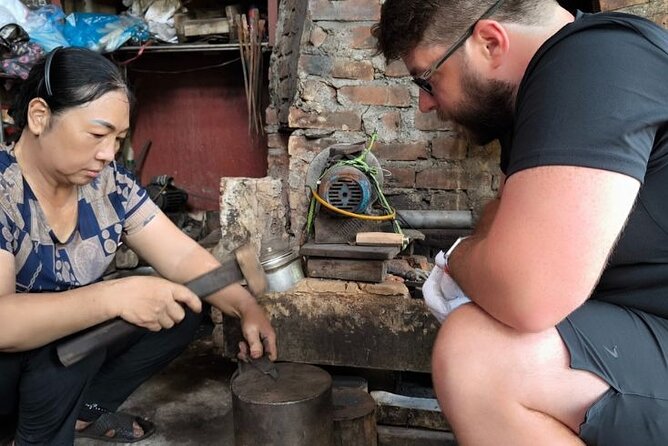
The setting gives the activity its character. Da Sy is a traditional forging village in the Hanoi area with a history stretching back several hundred years. It once supplied weapons during Vietnam’s wars. Today, its workshops continue the trade through agricultural tools and household knives.
That change tells you something useful about the class. You are not entering a staged museum display built only for visitors. You are seeing a working craft tradition that has adapted to ordinary life. The workshop connects an old village skill with objects people still use.
The village visit also gives you a look at Hanoi beyond the central streets. The experience is a good fit if you have already visited the Old Quarter and want an activity tied to local work rather than another sightseeing stop. You will spend much of the time at the workshop, so do not book this expecting a long walking tour through the entire village.
A few other Hanoi trips to compare
- Hanoi Cooking Class: Culture, Local Market & Meaning CSR Impact
★ 5.0 · 5,147 reviews - 5 Traditional Dishes Hanoi Cooking Class with Market Trip
★ 5.0 · 4,890 reviews - Hanoi Coffee Workshop: Taste Salt, Coconut and Egg Coffee
★ 5.0 · 1,286 reviews
Hotel pickup and the trip out from Hanoi
Pickup is included from your hotel. You are asked to wait five minutes in the hotel lobby, which is a small but useful detail in Hanoi, where traffic and hotel entrances can make meeting points less clear than expected.
An English-speaking guide accompanies the journey. Guides named Tee, Nathan, Khoi, and Minh have led sessions, and their role is important because the local makers may not speak English. The guide explains the village and the work, translates instructions, and helps keep the activity moving.
Nathan, in particular, has also been praised for explaining Vietnamese history, people, fruit, tea, and sweets during the drive. Tee has been described as helpful with translation and photography. Khoi has been noted for looking after people from pickup through the return trip, while Minh has handled groups and safety explanations well.
Exact driving time is not provided, so I would not build a tight connection around the class. Plan on the full three-hour activity plus transport time. Starting times vary, so check availability before booking.
Choosing the knife before the fire starts
The class begins with a design choice. You can select from offered knife shapes, and some sessions allow you to bring a photo or request a personal design. One participant combined a local style with a Japanese kiritsuke shape, while others chose kitchen knives.
You then sketch the blade on a sheet of metal selected for durability. This step matters more than it may seem. Blade length, curve, point, and handle shape affect how the finished knife feels in your hand. You are not simply receiving a standard souvenir from a shelf. You have a say in the object’s form.
The choice may be more limited in a larger group than during a private session. If you have a particular shape in mind, show the guide a photo at the start. It is also sensible to ask what can realistically be made in the available time.
Heating, cutting, and hammering the blade
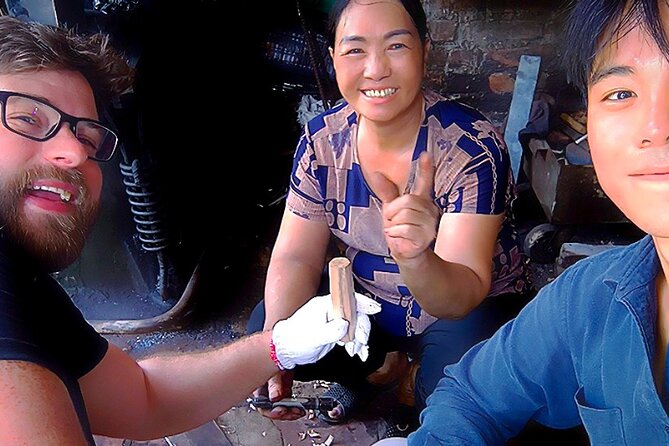
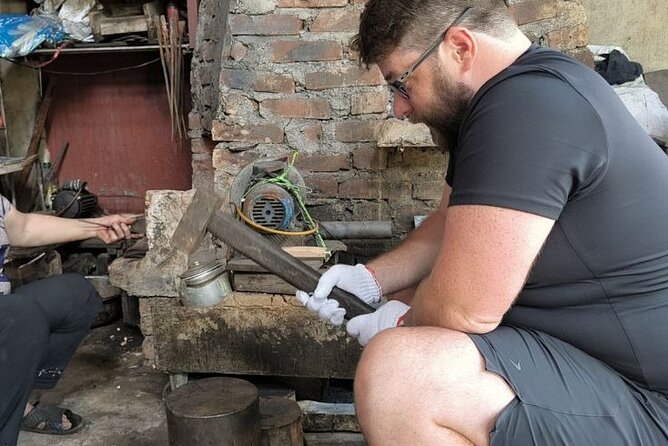
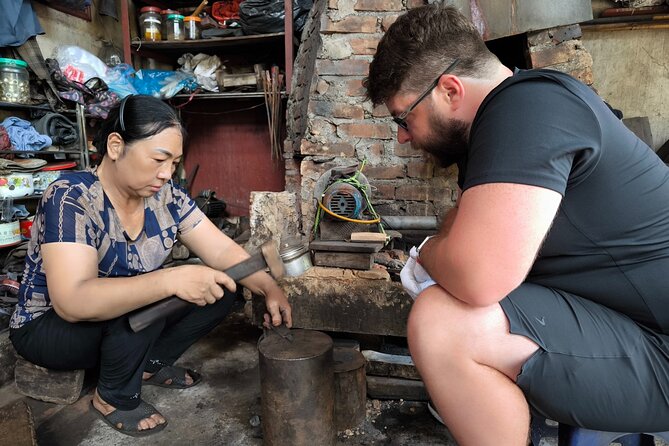
The central part of the workshop takes place beside the forge. The metal is heated in crackling embers until it can be worked. Using a hammer, cutter, and anvil, you help cut out the blade and tang, the section that extends into the handle.
You will then take turns with the maker, striking the metal to stretch and shape it. This is the most physical part of the class. The appeal is not perfect technique. It is feeling the force, heat, and timing behind a tool that normally appears finished and effortless in a shop.
Safety controls how much you do. You can take part in many steps under supervision, but the master may guide your grip, correct your stance, or complete a difficult section. One useful choice offered in some sessions is to do nearly everything yourself or let the craftsperson handle most of the work.
That flexibility is a strength for first-time makers. It also explains the one real limitation of the class. If you already have substantial metalworking or DIY experience, you may find that the session is more guided demonstration than serious technical training. You might hammer only a few times while the master ensures the blade comes out straight and usable.
For a first attempt, that trade-off makes sense. The goal is a safe, attractive knife, not a risky test of whether you can forge a blade without help.
Same base, a completely different day:
- Hanoi Jeep Tour: Food, Culture and Fun by Vietnam Army Jeep
★ 5.0 · 15,222 reviews - Full-Day Ninh Binh Highlights Tour from Hanoi
★ 5.0 · 7,761 reviews - Hanoi: Ha Long Bay Day Cruise – Swimming, Meal, Kayaking
★ 4.7 · 7,415 reviews - Hanoi: Water Puppet Show Tickets
★ 4.6 · 7,029 reviews
Trimming and shaping with workshop machinery
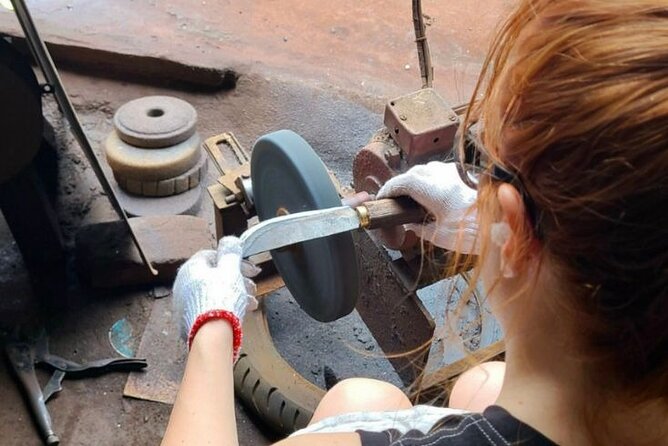
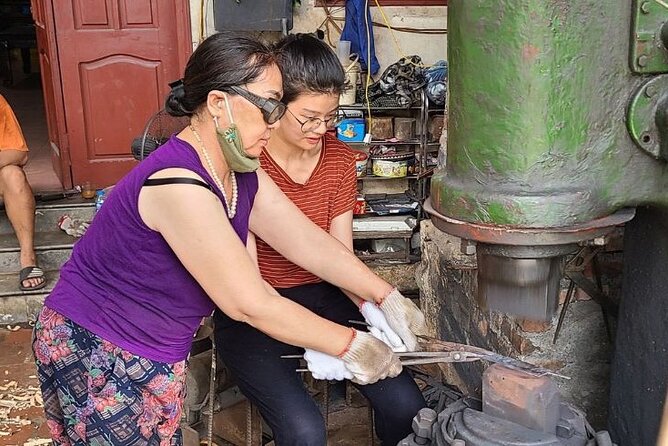
After the rough forging, any uneven parts are trimmed with a hydraulic cutting machine. This is one of the stages you should expect the professionals to control. The machinery is powerful, and the finished blade depends on accurate cuts.
You still remain involved in the process, watching how the rough piece becomes a recognizable knife. The guide can explain what is happening and translate any instructions from the maker. In a small group, you may get more direct attention and more time to ask questions.
This is also where expectations matter. The class lets you take part in knife making, but it does not mean every operation is performed entirely by you. Think of it as supervised participation. You shape the experience and contribute to the work, while an experienced craftsperson protects both your fingers and the quality of the final blade.
Sharpening, tempering, and the family recipe
The blade is sharpened on a grindstone in several stages. This is the point where the rough metal begins to look and feel like a finished tool.
One stage involves soaking the blade in a tar-based chemical wash made from a secret family recipe. The class description identifies this as part of the sharpening process, but it does not give the formula or technical details. You should follow the maker’s instructions closely and avoid treating the chemicals as something to handle casually.
The finishing work shows why local skill matters. A sharp blade is not simply a piece of steel ground down at the edge. Its usefulness depends on the shape, balance, hardness, and finish. You may help with tempering and polishing, but the master’s eye ensures the result works as a knife rather than merely looking like one.
Several people have finished with surprisingly sharp, professional-looking blades. That is a credit to the craftsperson’s supervision, especially when the participant has no prior experience.
Making the handle and personal fit
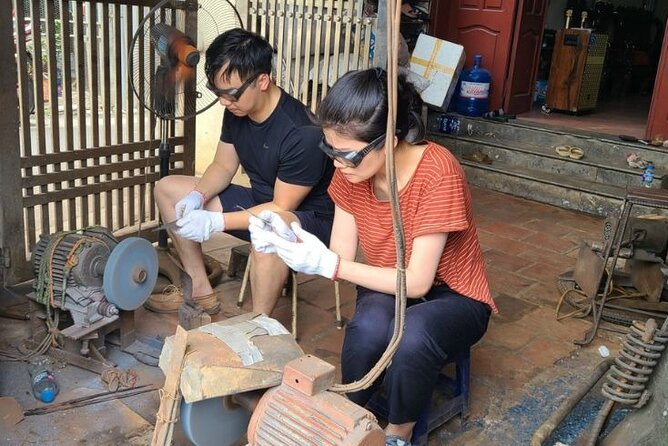
The handle gives you another chance to leave a personal mark. You may help carve or shape the wooden handle and adjust it to fit your hand. This is one of the most appealing parts for anyone who wants a souvenir with a story.
A factory-made knife can be attractive, but it does not carry the memory of heating steel, striking an anvil, and working beside a village maker. Here, the handle can reflect your preferred shape and grip, within the limits of the workshop and the time available.
The class may produce different kinds of knives, including kitchen knives and other practical designs. Ask about the available options before the metal is cut. A knife intended for display, cooking, or general household use may need a different shape.
At the end, the knife is yours to keep. That makes the $50 price easier to justify. You are paying for transport, instruction, equipment, local guidance, and a finished product, not only for a short demonstration.
Tea, snacks, and meeting the makers
The social side of the workshop is modest but memorable. At the end, you may sit with the family over tea and a snack, and some guides introduce local fruit, sweets, or drinks during the day.
This time matters because the craft is tied to people, not just tools. You can chat through the guide, ask how the workshop works, and see the space where the family practices its trade. The welcome has been a repeated strength of the experience, with the makers described as patient and friendly.
Do not expect a formal lecture or a large visitor center. The charm comes from the direct contact and the working atmosphere. If you prefer polished attractions with clear stages and displays, this may feel basic. If you like meeting people through the work they do, it is a good match.
Some sessions also allow you to buy additional knives at reasonable prices. Any extra purchase is separate from the activity, and you should ask about the price and intended use before buying.
How much hands-on work will you really get?
Your level of participation depends on the group, the knife design, and your comfort around heat and machinery. In a private session, you may have time to complete most steps with close help. In a group of six, each person can still make a knife, but attention naturally moves between participants.
You can expect to:
- Choose or adapt a knife design
- Sketch the blade
- Help cut the blade and tang
- Hammer and shape heated metal
- Watch or assist with machine trimming
- Help sharpen and finish the blade
- Work on the handle
- Take the completed knife home
The makers will not let you wander into unsafe work. Wear the gloves provided and follow instructions around the forge, grindstone, chemicals, and hydraulic machine. Comfortable shoes are required, and closed shoes are the sensible choice for a workshop with hot metal, though the supplied information only specifically asks for comfortable footwear.
This is suitable for true beginners. You do not need blacksmithing skills. It is less suitable if your main goal is to master forging theory or work independently without intervention.
Price, timing, and who gets the best value
The listed price is $50 per person for three hours. Since it includes hotel pickup, an English-speaking guide, equipment, water, instruction, and the knife, I consider it good value for Hanoi. A handmade object that you can use is more meaningful than many standard souvenirs, and the village setting adds substance to the outing.
A 500-milliliter bottle of water is included. Bring comfortable shoes, and avoid alcohol and drugs, which are not allowed during the activity.
The workshop is especially well suited to:
- Couples who want a shared project
- Families with older children or teenagers
- Solo visitors who enjoy making things
- Anyone interested in knives, tools, or metalwork
- People who want to see a traditional craft village
- Visitors looking for a practical souvenir rather than a decorative trinket
It may not suit someone who dislikes heat, noise, physical work, or close supervision. People over 95 are listed as unsuitable for the activity. The experience is also a poor choice if you want a quiet cultural tour with no machinery.
There is free cancellation up to 24 hours before the activity, and you can reserve now and pay later. A $10 surcharge applies on New Year and Tet holidays, Liberation Day or Reunification Day on April 30, International Workers’ Day on May 1, and National Day on September 2.
What I would ask before booking
I would first confirm the pickup point and starting time. Hotel pickup is included, but the exact schedule depends on availability.
I would also tell the operator what sort of knife I want. A photo can help, especially if you want a particular blade profile or a handle that fits your hand. Ask how much of the work you will do yourself, since this can vary by design and group size.
If you are booking for several people, ask about group size. Small groups and private sessions offer more time beside the master. Larger groups can still be fun, but you may spend more time watching while the maker moves from person to person.
Finally, remember that this is a knife-making activity. Check your airline and destination rules before packing the finished knife in your luggage. The class provides the product, but transport regulations are outside the workshop’s control.
Should you book the Hanoi knife-making workshop?
I would book it if you want a personal, practical souvenir and enjoy learning through your hands. The combination of hotel pickup, English translation, a family workshop, and a finished knife gives the $50 fee real value.
Book with the right expectations. You will not become a trained blacksmith in three hours, and some of the hardest work will remain with the master. But you will see the full process, contribute to many stages, meet local makers, and take home an object linked to your time in Vietnam.
For a more private experience, choose a small group if available and bring a clear knife design. For a relaxed first taste of forging, the standard session should do the job well.
FAQ
Where does the knife-making workshop take place?
The workshop takes place in Da Sy village in the Hanoi area. The listed location is Dong Bac, Vietnam, and hotel pickup is included.
How long does the activity last?
The stated duration is three hours. Starting times vary, so check availability when booking.
Is hotel pickup included?
Yes. Pickup from your hotel is included. You should wait five minutes in the hotel lobby for the guide.
Is the workshop conducted in English?
Yes. English-speaking instruction and a live English tour guide are included. Guides help translate between you and the local knife makers.
What should I bring?
Bring comfortable shoes. A 500-milliliter bottle of water is included, along with the equipment and materials needed for the class.
Can I cancel or pay later?
You can cancel up to 24 hours in advance for a full refund. Reserve now and pay later is also available.
Newly listed around Hanoi
- Hanoi: Halong Bay Cruise, Amazing Cave, Titov Island & Kayak★ 4.2 · 39 reviews
- 2Days-1Night Halong Bay Luxury Genesis Regal Cruises★ 4.5 · 39 reviews
- Ninh Binh 1 Day Tour(Tam Coc – Mua Cave – Bich Dong)★ 5.0 · 39 reviews
- 8 days 360° Vietnam Adventure from Hanoi★ 5.0 · 39 reviews
- Dora Cruise – Luxury 5 Star Cruise in Halong Bay & Lan Ha Bay (2D1N)★ 4.5 · 39 reviews
- 3 Days and 2 Nights Ha Giang Loop Tour★ 5.0 · 39 reviews
- Best Value Ha Long bay 1 day – Lunch, kayak, swimming, transfer★ 5.0 · 39 reviews
- From Hanoi: Ha Giang Loop Motorbike Tours 3-Days 2-Nights★ 5.0 · 40 reviews
Hanoi Tours, compared.

Hanoi Jeep Tour: Food, Culture and Fun by Vietnam Army Jeep
Read our review →
Full-Day Ninh Binh Highlights Tour from Hanoi
Read our review →
Ha Long Bay Day Cruise – Swimming, Meal, Kayaking
Read our review →

Hanoi Motorbike Tour: Food, Culture and Fun by Vintage Motorbike
Read our review →

Hanoi Cooking Class: Culture, Local Market & Meaning CSR Impact
Read our review →
5 Traditional Dishes Hanoi Cooking Class with Market Trip
Read our review →Browse the lists this tour appears in