
Reviewed · HANOI TOURS
Hanoi Knife Making Traditional Workshop
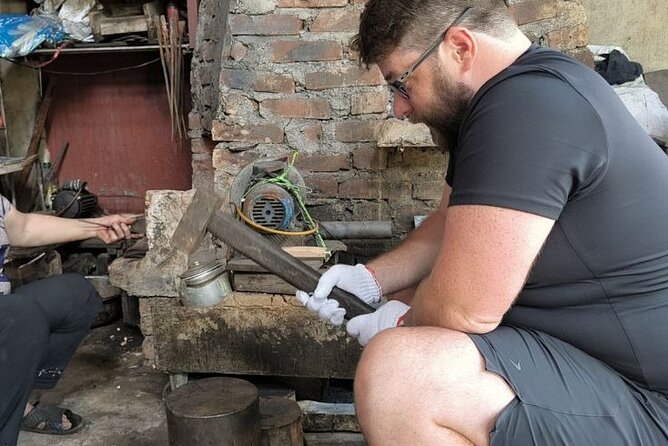
The most unusual souvenir in Hanoi may be one you help make yourself. At this three-and-a-half-hour knife workshop, you work beside a family of village blacksmiths, heat iron in glowing coals, strike it with a hammer, and shape a simple cooking knife from scratch.
I like two things here: you take part in every main stage, and you meet craftspeople whose family trade has lasted for generations. I also like the small group limit of 10, which should give you more time at the anvil instead of leaving you watching from the side.
The main caution is that this is real forge work, not a polished craft demonstration. You need moderate physical fitness, and the heat, hammering, grinding, and sharp tools may not suit everyone. Lunch is not included, so plan around the half-day schedule.
Key points at a glance
- Make a usable souvenir: You sketch, cut, forge, shape, and sharpen a simple knife.
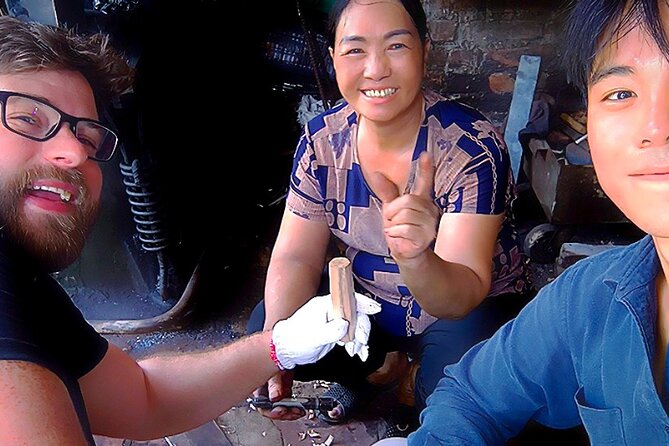
- Work with a multigenerational family: The local makers learned the trade young, with one family member explaining that training can begin around age 12.
- Get close to traditional forging: The village once supplied weapons during Vietnam’s wars and now focuses on agricultural tools and practical blades.
- Keep the group small: A maximum of 10 people makes hands-on instruction more realistic.
- Meet an English-speaking guide: Nathan is named as one guide who helps keep the trip moving and the workshop engaging.
- Budget for food and tips: The $50 price includes transport, iron, and the guide, but not lunch or gratuities.
From Hanoi to a village built around the forge
This experience begins in Hanoi, with pickup offered and an air-conditioned vehicle included. The supplied details do not give a fixed pickup time or identify the exact village by name, so check those points when you book. The listed duration is about 3 hours and 30 minutes, making this a manageable half-day outing rather than a full-day commitment.
The trip takes you to a traditional craft village on Hanoi’s outskirts. Forging has been practiced there for several hundred years. During the wars, the village was known as an important source of weapons. Today, the work is more closely tied to daily life, with local makers producing agricultural implements and other practical metal goods.
That change tells you something useful about the class. You are not entering a staged museum display. You are visiting a working craft setting where the skills once used for weapons now support ordinary tools and household objects. The experience connects a finished knife to the wider role of metalwork in village life.
An air-conditioned vehicle matters in Hanoi, especially after time spent near a hot forge. Still, the transport portion is only one part of the outing. The heart of the experience begins when you sit down with the makers and decide what kind of knife you will create.
A few other Hanoi trips to compare
- Hanoi Cooking Class: Culture, Local Market & Meaning CSR Impact
★ 5.0 · 5,147 reviews - 5 Traditional Dishes Hanoi Cooking Class with Market Trip
★ 5.0 · 4,890 reviews - Hanoi Coffee Workshop: Taste Salt, Coconut and Egg Coffee
★ 5.0 · 1,286 reviews
Sketching the blade before the fire
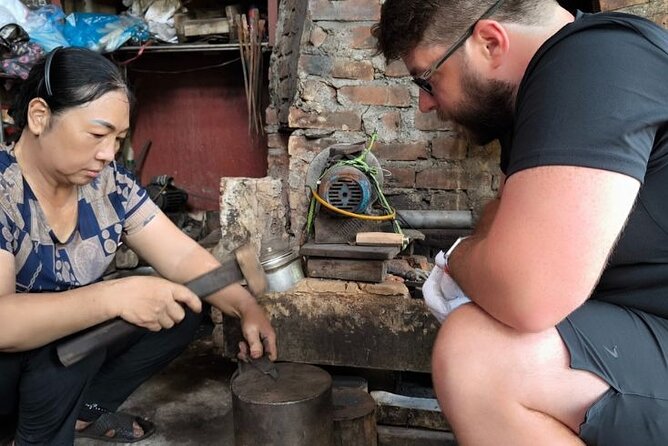
Your first practical task is to sketch the blade shape on a sheet of metal selected for durability. This step may look simple, but it affects the final object. The outline determines the general size and form of the knife, including the blade and the tang, the metal section that extends into the handle.
You may have some choice over the knife’s size. One account describes the family allowing participants to pick the size of their blade, though the exact options are not specified. Ask the makers what is practical before you draw. A smaller design may be easier to finish within the allotted time, while a larger one could require more work and strength.
The sketch also gives you a clear sense of ownership. You are not simply receiving a knife made in the village. You are helping decide its shape before the metal reaches the fire. That makes the finished piece a much more personal souvenir than a standard market purchase.
The local family members guide this stage and the work that follows. Their experience is clear in the way they handle the metal and tools. A family member explained that people in the trade can begin learning at around 12 years old, which helps explain the confident, practiced movements you will see around the forge.
Cutting the iron and facing the anvil
Once the shape is marked, you use a hammer, cutter, and anvil to cut out the blade and tang. The metal then goes into the crackling embers, where it becomes workable under heat.
This is the point where the class becomes physical. You are not only holding a tool for a quick photo. You need to strike, watch the metal, and follow instructions from the maker working beside you. The hammering takes effort, and your technique may feel awkward at first. That is part of the appeal, but it is also why the moderate fitness requirement matters.
You will likely alternate blows with the maker as the blade takes shape. The local craftsperson brings the precision, while you provide some of the force and learn the rhythm. This shared work is one of the strongest parts of the experience. It lets you see how much control is required to make a clean, even blade.
The process is not presented as a race. Patience matters more than power. If you swing too hard or lose the angle, the maker can guide the next step. The family is described as patient and helpful, an important detail for anyone who has never used a forge.
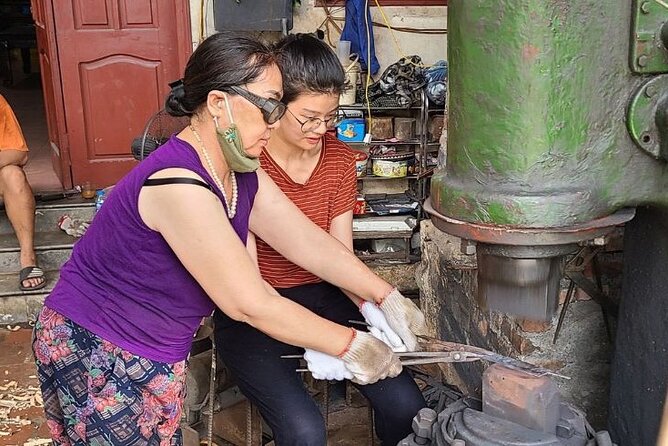
A hydraulic cutting machine is used to trim imperfections. That tool helps bring the rough blade closer to its intended outline. It also means you are not expected to produce a perfect shape with hand tools alone. The experience keeps the traditional handwork at its center while using practical equipment to correct rough edges.
Shaping a knife with a local maker
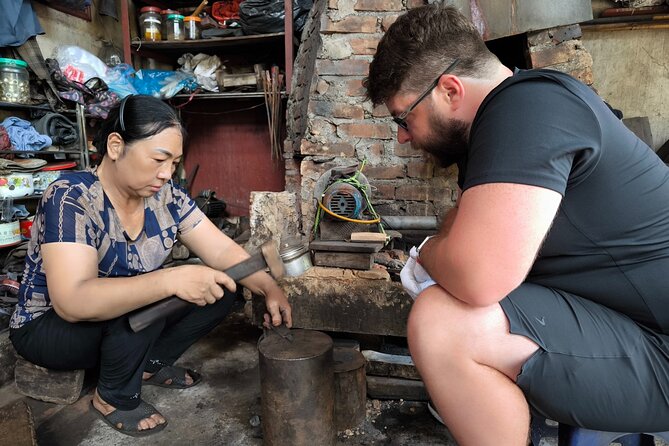
Forging a blade is a series of small corrections. The metal changes as you work it, and the maker watches for uneven sections, unwanted edges, and problems in the tang. You take part in the process, but the family’s experience keeps the work on track.
This balance is important when you consider the price. At $50 per person, you are paying for more than a short demonstration. The fee includes the iron material, an English-speaking guide, and an air-conditioned vehicle. Most importantly, it includes access to a hands-on craft session that would be difficult to arrange independently.
The value is strongest if you want an activity that gives you a physical connection to Hanoi’s surrounding villages. If your main aim is sightseeing, the price may feel high for a half-day trip focused on one object. If you enjoy making things, meeting local people, and bringing home something that carries a story, the cost is easier to justify.
The maximum group size is 10. That is not a private class, but it is small enough to make direct help possible. In a larger group, you might spend much of the time waiting for a turn. Here, the setup is better suited to alternating between instruction, hammering, and watching the maker correct the blade.
An English-speaking guide helps with the wider trip and communication. Nathan is identified as one guide for this experience. If he leads your departure, you can expect help during the journey as well as conversation and explanations at the workshop. Guide assignments can vary, so it is best not to assume Nathan will be present on every date.
Same base, a completely different day:
- Hanoi Jeep Tour: Food, Culture and Fun by Vietnam Army Jeep
★ 5.0 · 15,222 reviews - Full-Day Ninh Binh Highlights Tour from Hanoi
★ 5.0 · 7,761 reviews - Hanoi: Ha Long Bay Day Cruise – Swimming, Meal, Kayaking
★ 4.7 · 7,415 reviews - Hanoi: Water Puppet Show Tickets
★ 4.6 · 7,029 reviews
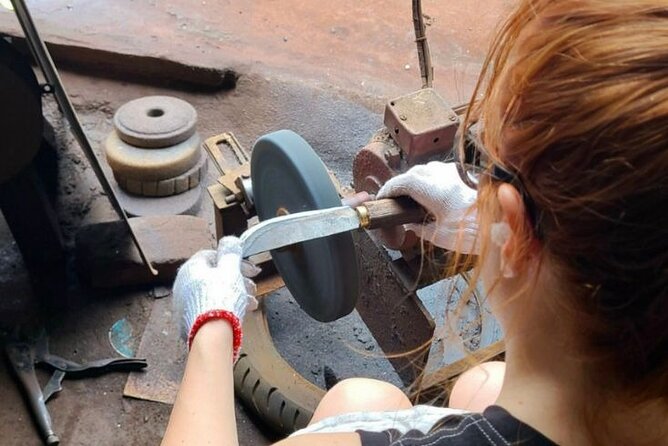
Grinding, sharpening, and the final edge
After the blade has been shaped, it is sharpened on a grindstone. This is a separate skill from forging. The edge needs to be refined carefully, and the work takes place in several phases.
One stage includes soaking the blade in a special tar-based chemical wash made from a secret family recipe. The details of the recipe are not provided, and the workshop does not present it as something you recreate yourself. Instead, it is part of the family’s finishing process and gives you a glimpse of the techniques passed down within the trade.
The grinding stage may be less dramatic than the hot forge, but it is where the knife begins to look and function like a finished tool. You can see the rough metal become a sharper, cleaner object. The transition from a marked sheet of iron to a usable blade is what gives the class its satisfying shape.
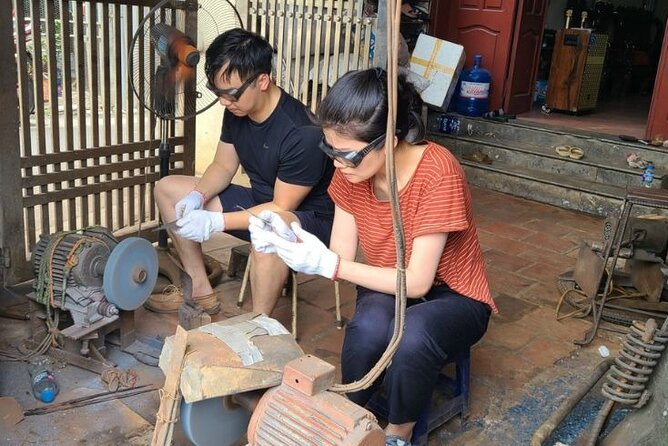
You should follow all instructions closely around the grindstone, chemical wash, and hot metal. The activity involves heat, hammers, cutting equipment, and a sharp blade. The stated moderate fitness requirement is only part of the practical consideration. You also need to be comfortable working carefully in a genuine workshop environment.
The supplied information does not specify a handle-making stage. The described process ends with the blade being sharpened, so you should confirm exactly what is included in the finished knife before booking. You will take home a knife, but the details of the handle and final presentation are not stated.
A souvenir with a better story than a souvenir shop
I like the fact that the finished item is not merely decorative. The class is centered on a simple cooking knife, a tool connected to everyday use. Each time you prepare food with it, the object can bring back the village, the family forge, and the effort that went into shaping the metal.
The experience also gives you a clearer idea of how traditional craft survives. The village’s old forging skills have shifted from wartime production to agricultural tools and practical knives. That is a more useful story than a broad claim about tradition because you can see how the work has adapted to present needs.
The family setting adds another layer. You are not being taught by an anonymous instructor in a purpose-built tourist studio. You meet local makers whose knowledge has been handed down through generations. The trade’s early training, sometimes beginning at age 12, shows how much practice sits behind the smooth movements you may find difficult on your first attempt.
Expect friendly instruction, but do not expect to become a master bladesmith in one session. The class teaches you the main stages of knife making and lets you perform parts of the work. The family’s skill remains essential, especially when correcting the shape, handling the equipment, and finishing the edge.
Who will get the most from this half-day class
This is a good choice if you want an unusual activity away from Hanoi’s main sights. It suits people who enjoy practical workshops, local craft, and souvenirs with a clear connection to place. It can also work well for couples, families with older children, and small groups looking for something more active than a standard village visit, provided everyone can manage the physical work.
It is especially appealing if you have already seen Hanoi’s major temples, markets, and food spots and want to use part of a day for something different. The village visit gives you contact with local makers, while the class gives you a task to focus on.
You may want to skip it if you dislike heat, repetitive hammering, sharp tools, or industrial workshop noise. The activity is not designed as a relaxed craft lesson with a guaranteed perfect result. Your knife will be shaped with professional help, but the point is to take part in the process.
The $50 fee makes the most sense when you value the full package: transport from Hanoi, guide support, the iron material, access to the family workshop, and the finished knife. Group discounts may be available, which could improve the price for a party booking together. Lunch is not included, so allow for your own meal before or after the class.
The experience has a 5.0 rating from 72 reviews and a 100 percent recommendation rate, with particular praise for the patient family instruction and the unusual nature of the souvenir. Those details match the practical strengths of the class: it offers direct participation, a small maximum group, and a finished object that you help create.
Booking details worth checking before you go
Confirmation is provided at booking. Pickup is offered, but the supplied information does not give the exact pickup point, departure time, or village address. Confirm those details, along with the likely guide and what the final knife includes.
The class requires a minimum number of participants. If that minimum is not met, the provider may offer another date or experience, or give you a full refund. Poor weather can also cause a cancellation, with the same choice of a different date or a full refund.
You can cancel for a full refund up to 24 hours before the start time. Changes or cancellations made within 24 hours are not refunded or accepted. Cutoff times use Hanoi’s local time, so check the clock carefully if you are arranging the class near the end of your trip.
Tips are not included. They are optional, but you may wish to budget one if the family and guide give you careful help throughout the session.
Should you book the Hanoi knife workshop?
Book it if you want a hands-on village experience and like the idea of returning home with a useful object rather than a mass-produced trinket. The family instruction, traditional forge work, small group limit, and chance to shape a knife from raw metal give this outing a clear purpose.
Think twice if you want a gentle sightseeing trip, have limited physical stamina, or are uncomfortable around fire and sharp tools. Also confirm the final knife details before paying, since the provided description explains the blade-making and sharpening stages but not the handle work.
For the right person, this is a memorable use of half a day in Hanoi. You leave with more than a knife. You leave with a better feel for the patience, heat, and repeated practice behind a village trade.
FAQ
How long does the Hanoi knife-making workshop last?
The experience lasts approximately 3 hours and 30 minutes.
How much does the workshop cost?
The listed price is $50 per person. Group discounts are offered.
What is included in the price?
The price includes an air-conditioned vehicle, iron material, and an English-speaking tour guide.
Is pickup from Hanoi available?
Pickup is offered. The exact pickup details are not specified in the supplied information, so confirm the meeting arrangements when booking.
What will I do during the knife-making class?
You sketch the blade, cut the blade and tang, heat the metal in embers, help hammer and shape it, trim imperfections, and sharpen it on a grindstone. The finishing process also includes a tar-based chemical wash made from a family recipe.
Is lunch included?
No. Lunch is not included, and tips are also excluded from the price.
What is the cancellation policy?
You receive a full refund if you cancel at least 24 hours before the experience start time. Cancellations or changes made less than 24 hours before the start time are not accepted or refunded. Poor weather or failure to meet the minimum number of participants may lead to a rescheduled experience or a full refund.
Newly listed around Hanoi
- Hanoi: Halong Bay Cruise, Amazing Cave, Titov Island & Kayak★ 4.2 · 39 reviews
- 2Days-1Night Halong Bay Luxury Genesis Regal Cruises★ 4.5 · 39 reviews
- Ninh Binh 1 Day Tour(Tam Coc – Mua Cave – Bich Dong)★ 5.0 · 39 reviews
- 8 days 360° Vietnam Adventure from Hanoi★ 5.0 · 39 reviews
- Dora Cruise – Luxury 5 Star Cruise in Halong Bay & Lan Ha Bay (2D1N)★ 4.5 · 39 reviews
- 3 Days and 2 Nights Ha Giang Loop Tour★ 5.0 · 39 reviews
- Best Value Ha Long bay 1 day – Lunch, kayak, swimming, transfer★ 5.0 · 39 reviews
- From Hanoi: Ha Giang Loop Motorbike Tours 3-Days 2-Nights★ 5.0 · 40 reviews
Hanoi Tours, compared.

Hanoi Jeep Tour: Food, Culture and Fun by Vietnam Army Jeep
Read our review →
Full-Day Ninh Binh Highlights Tour from Hanoi
Read our review →
Ha Long Bay Day Cruise – Swimming, Meal, Kayaking
Read our review →

Hanoi Motorbike Tour: Food, Culture and Fun by Vintage Motorbike
Read our review →

Hanoi Cooking Class: Culture, Local Market & Meaning CSR Impact
Read our review →
5 Traditional Dishes Hanoi Cooking Class with Market Trip
Read our review →Browse the lists this tour appears in