
Reviewed · HANOI TOURS
Hanoi Knife-Making Class:Join the Legacy in Blacksmith’s Workshop
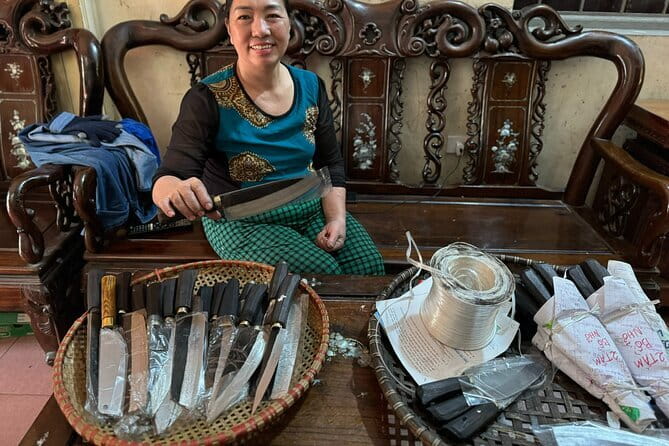
Da Sy is not a polished museum set. It is a working blacksmithing village where hot metal, hammers, anvils, and generations of skill still shape everyday tools. In this hands-on knife class, you work with artisan Tuyen, the only officially recognized woman in the trade, who has spent 44 years preserving the craft.
I like two things right away: you make a useful object rather than a decorative trinket, and the class takes place in an artisan’s home workshop. The rare tar-based sharpening method adds a detail you are unlikely to find in a standard craft lesson. The main consideration is that this is active work, not a quiet craft session. You will hammer, grind, and handle hot metal, so comfort with physical effort matters.
Key points
- A working village, not a staged attraction: Da Sy has centuries of blacksmithing tradition and once supplied weapons during Vietnam’s wars.
- Led by artisan Tuyen: She has 44 years in the craft and is recognized as the village’s only officially certified female artisan.
- You shape the whole knife: Choose a design, cut the metal, forge the blade and tang, work on the handle, and sharpen the edge.
- A rare finishing method: The sharpening process includes an old tar-based wash kept within the artisan’s family tradition.
- A small-group class: The maximum group size is 10, which allows room for individual instruction.
- A functional souvenir: You leave with a handmade knife, though you should check your home country’s rules before carrying it on a flight.
Da Sy, where blacksmithing is part of daily life
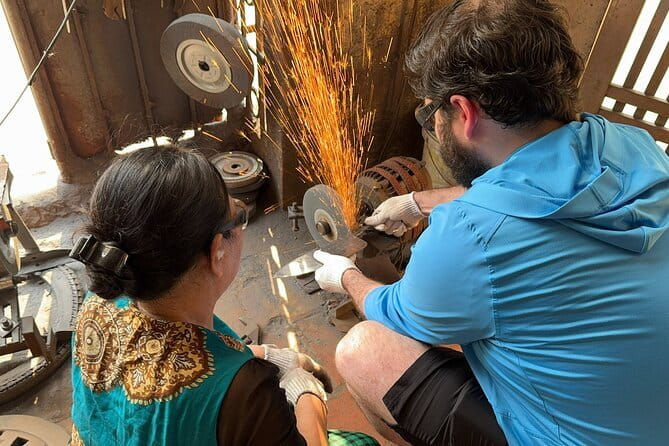
The trip begins at Đa Sỹ, Kiến Hưng, Hà Đông, on the western side of Hanoi. This village is known for centuries of forging, with a reputation built on blades and tools rather than tourist displays.
That setting gives the class its real value. You are not simply shown an old technique by someone performing for an audience. You work inside an active artisan environment, surrounded by the tools and methods that give Da Sy its identity. The village also has a serious historical connection to Vietnamese metalwork. It was once known for supplying weaponry during the country’s wars.
The class lasts about two and a half hours. That is enough time to move through the main stages without turning the day into a full apprenticeship. It is also long enough for you to see the difference between a rough piece of steel and a finished blade made to your own choices.
Your guide helps explain the process and translate the artisan’s instructions. Names associated with the class include Mint, Nick, and Tulip, depending on the scheduled guide. Nick is also known for sharing Hanoi food suggestions, a useful bonus if you are planning the rest of your stay.
A few other Hanoi trips to compare
- Hanoi Cooking Class: Culture, Local Market & Meaning CSR Impact
★ 5.0 · 5,147 reviews - 5 Traditional Dishes Hanoi Cooking Class with Market Trip
★ 5.0 · 4,890 reviews - Hanoi Coffee Workshop: Taste Salt, Coconut and Egg Coffee
★ 5.0 · 1,286 reviews
Choosing a blade before the fire starts
The first step is design. You sketch the blade on a selected piece of durable metal, with the shape and size guided by the type of knife you want to make.
This is a small but important part of the class. You are not handed a finished template and told to copy it without thought. Your drawing becomes a plan for the blade, the tang, and eventually the handle. Several people have made compact knives around 14 centimeters long, while others have chosen different shapes and handle styles.
Be realistic here. A custom design is part of the fun, but the final shape still has to work with the available metal and the artisan’s methods. Tuyen and the workshop team guide you toward a design that can actually be cut, forged, sharpened, and used.
The class can work well for a couple or small group making one knife together. One participant booked a single place because the goal was to create one shared knife, not one per person. If you want each person to leave with a blade, confirm how the booking handles additional knives before you arrive.
Cutting the metal and building the tang
Once the design is selected, you cut out the blade and tang. The tang is the section that fits into the handle, so it is not just a spare strip of metal. It connects the blade to the part you hold and helps give the finished knife its structure.
Traditional tools are central here. You use cutters, hammers, and an anvil, with safety equipment supplied at the workshop. The work can feel demanding, especially if you have never handled blacksmithing tools. That is part of the point. The knife does not appear through a quick demonstration. You take part in the force and repetition needed to shape it.
The metal is then heated in the forge. This is the moment when the class shifts from drawing and cutting into real blacksmithing. Under the artisan’s direction, you take turns working the heated metal and begin to bring the outline into a usable blade.
I like this stage because it shows how much judgement sits behind a simple kitchen tool. Heat, timing, hammer control, and the angle of each strike all affect the result. You will not suddenly become a master smith in one session, but you will gain a clear sense of why the trade takes years to learn.
Hammering beside a 44-year artisan
Tuyen is the central figure in the workshop. She has worked in knife-making for 44 years and is the only officially recognized female artisan in the trade. Her long career matters because beginners need close guidance when working with hot steel and heavy tools.
The class is collaborative rather than fully independent. You do the work, but the artisan helps keep each stage safe and workable. The instruction is step by step, and beginners are supported as they learn how to hold, strike, and reposition the metal.
That support also keeps the class from becoming frustrating. A first-time maker will not have the strength or accuracy of a professional blacksmith. The artisan can correct rough sections and help keep the knife on course while leaving enough of the work in your hands to make the finished piece feel personal.
The small maximum of 10 people helps here. It is not a private lesson by default, but it is much more manageable than a large group gathered around one demonstration. If you want one-on-one attention throughout, ask about the private class option before booking.
Same base, a completely different day:
- Hanoi Jeep Tour: Food, Culture and Fun by Vietnam Army Jeep
★ 5.0 · 15,222 reviews - Full-Day Ninh Binh Highlights Tour from Hanoi
★ 5.0 · 7,761 reviews - Hanoi: Ha Long Bay Day Cruise – Swimming, Meal, Kayaking
★ 4.7 · 7,415 reviews - Hanoi: Water Puppet Show Tickets
★ 4.6 · 7,029 reviews
Hydraulic shaping and the hard work between stages
After the main forging, a hydraulic machine helps refine rough edges. This is a practical touch. Traditional hand tools shape the character of the knife, while the machine helps bring the surface closer to a clean finish.
You should not expect every part of the work to be done by hand. That would be slow, difficult, and potentially unsafe for beginners. The combination of old tools and modern workshop equipment is more sensible. You get the feel of the craft without pretending that a professional forge refuses every useful machine.
This is also where the class may feel less relaxed than pottery, coffee, or jewelry workshops. The work involves heat, noise, physical effort, and attention. Some people will find that exciting. If you want a quiet afternoon activity with little exertion, this is probably the wrong choice.
The best approach is to treat the machine as part of the lesson. It shows how a working forge balances heritage with practical production. Da Sy’s tradition has survived because its artisans make tools that function, not just objects that look old.
Carving the handle and giving the knife a personal touch
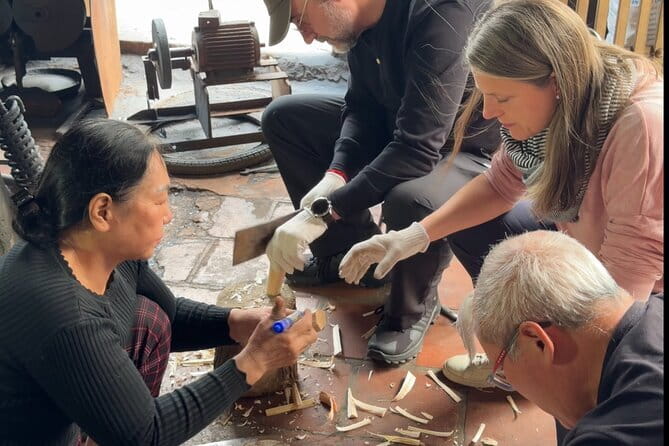
The handle brings the knife closer to a finished object. You begin with a block of wood, in some cases with bark still attached, and work it into a form that fits the blade and feels right in your hand.
This is one of the most personal sections of the class. The blade may follow a practical village tradition, but the handle gives you space to make the knife your own. You can choose the basic look and shape, then take part in carving and refining it.
The handle also makes the process easier to understand. At the start, you have a flat or rough piece of metal and a plain block of wood. By the end, the two parts have become one tool. That change is satisfying because you can see the result of every earlier step in the finished object.
Do not expect machine-shop perfection. Small marks and irregularities are part of a handmade knife. They are also a useful reminder that you made it with guidance, rather than buying a factory-made souvenir from a market shelf.
Grinding, honing, and the tar-based sharpening method
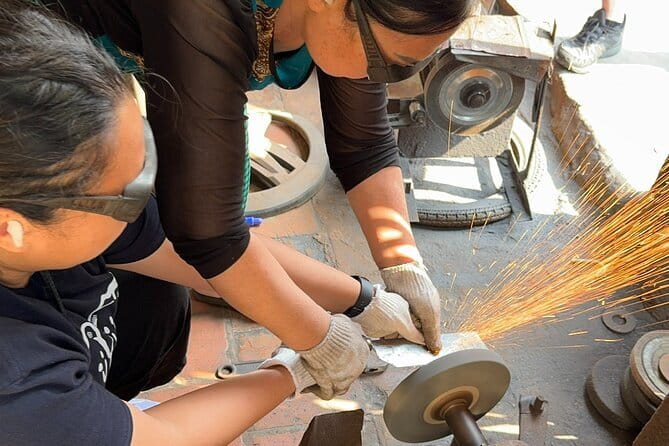
Sharpening is the final technical stage. You work on a grindstone and refine the edge through several steps. This requires care, since the angle matters and too much pressure can affect the blade.
The most unusual detail is the tar-based wash used during sharpening. It is described as an old family technique passed through generations. You are not simply rubbing the knife against a stone and calling it done. The process includes a local method that connects the practical job of sharpening with the workshop’s family knowledge.
This part may take patience. A blade does not become useful after a few quick passes. You may work through grinding, honing, and final sharpening before the edge is ready. Your guide and artisan help you understand the sequence and make sure the knife is handled correctly.
The result is a functional souvenir rather than a display piece. You can use it for cooking and remember the day each time it comes into your kitchen. Before you book, keep in mind that knife transport rules vary. Check your airline and home country regulations, especially if you plan to carry the knife in luggage or bring it through an airport.
What the $45.51 price really covers
At $45.51 per person, the class costs more than buying a basic knife in Hanoi. That comparison misses the main point. You are paying for roughly two and a half hours of instruction, access to a working forge, materials, tools, safety equipment, interpretation, and the finished knife.
The value is strongest if you want an activity with a lasting result. A market souvenir takes minutes to buy. This knife carries the memory of the village, the forge, the design you chose, and the work involved in shaping it.
The price is less compelling if you only want a cheap kitchen tool. A factory-made knife will cost less and may have a cleaner finish. Book this for the process and the connection to Da Sy, not because it is the cheapest way to acquire cutlery.
The group limit of 10 also helps protect the value. You are not guaranteed a private lesson, but the class is small enough for the artisans and guide to give individual help. Private bookings with a car have also been arranged, so ask the provider about that option if transport or personal instruction is important to you.
Timing, meeting point, and practical comfort
You meet at Đa Sỹ, Kiến Hưng, Hà Đông, Hanoi, and return to the same point when the class ends. The activity is near public transportation, and mobile tickets are accepted.
The meeting point is outside the central tourist core, so allow time to reach the village. The exact transport arrangements are not included in the supplied details, so confirm your route and pickup plans with Photheculture before setting out. If you arrange a car, agree on the pickup point clearly.
All necessary tools and safety equipment are provided at the artisan’s house. You do not need to bring blacksmithing gear. Since the class involves a forge, hammering, cutting, grinding, and sharpening, wear practical clothing and shoes that you do not mind using in a workshop.
Most people can take part, and service animals are allowed. Still, the physical nature of the work is worth considering. The class is not described as a passive demonstration, and you should expect to stand, handle tools, and follow safety instructions closely.
Free cancellation is available up to 24 hours before the local start time. Cancellations or changes inside that 24-hour window are not refunded or accepted.
Who will enjoy this knife-making class most
I would choose this class if you want a strong cultural activity that is also practical. It suits curious makers, couples, families with older children, cooks, and anyone who has already seen enough souvenir stalls.
It is especially good for people who like meeting craftspeople in their own work setting. Tuyen’s long career and the village’s blacksmithing tradition give the class a human focus that a standard workshop often lacks.
You may also like it as a final-day activity. The class leaves you with a physical object linked to Hanoi, rather than another photograph or mass-produced keepsake. Just leave enough time afterward if you need to sort out luggage and transport rules for the knife.
I would hesitate if you dislike noise, heat, or physical work. The class is not a slow, laid-back craft hour. It asks for attention and some effort, even though the artisans guide you through the difficult parts.
Should you book the Da Sy forge?
Book it if you want to make something real. The combination of a centuries-old village, a female artisan with 44 years of experience, a small group, and a knife you design and finish yourself gives this activity a clear identity.
The best reason to go is not the final blade alone. It is the chance to see how a working Vietnamese craft survives through family methods, practical tools, and patient teaching. At $45.51, the value is good for an interactive cultural class with materials included.
Skip it only if you want a passive tour or have no practical way to transport a knife home. For everyone else, this is one of Hanoi’s more unusual choices, and it gives you a story you can use in the kitchen long after the forge cools.
FAQ
Where does the knife-making class take place?
The class takes place at an artisan’s house in Đa Sỹ, Kiến Hưng, Hà Đông, Hanoi, Vietnam.
How long does the class last?
The activity lasts approximately 2 hours and 30 minutes.
What will I make during the workshop?
You will make a handmade knife. The process includes designing the blade, cutting the metal, forging and shaping the blade and tang, working on the handle, and sharpening the finished knife.
Is the class suitable for beginners?
Yes. The workshop provides step-by-step instruction from skilled artisans, and most people can participate. Safety equipment and all necessary tools are provided.
How many people can join the class?
The maximum group size is 10 participants.
Who leads the workshop?
The artisan is Tuyen, a female blacksmith with 44 years of experience and official recognition in the trade. Guides associated with the class include Mint, Nick, and Tulip.
Is transportation included?
The meeting and ending point is in Đa Sỹ, and the activity ends back there. The supplied details do not state that standard transportation is included. Private class arrangements with a car have been made, so confirm this option with the provider.
Can I cancel for a full refund?
Yes, if you cancel at least 24 hours before the experience start time. Cancellations or changes made less than 24 hours before the start time are not refunded.
Newly listed around Hanoi
- Hanoi: Halong Bay Cruise, Amazing Cave, Titov Island & Kayak★ 4.2 · 39 reviews
- 2Days-1Night Halong Bay Luxury Genesis Regal Cruises★ 4.5 · 39 reviews
- Ninh Binh 1 Day Tour(Tam Coc – Mua Cave – Bich Dong)★ 5.0 · 39 reviews
- 8 days 360° Vietnam Adventure from Hanoi★ 5.0 · 39 reviews
- Dora Cruise – Luxury 5 Star Cruise in Halong Bay & Lan Ha Bay (2D1N)★ 4.5 · 39 reviews
- 3 Days and 2 Nights Ha Giang Loop Tour★ 5.0 · 39 reviews
- Best Value Ha Long bay 1 day – Lunch, kayak, swimming, transfer★ 5.0 · 39 reviews
- From Hanoi: Ha Giang Loop Motorbike Tours 3-Days 2-Nights★ 5.0 · 40 reviews
Hanoi Tours, compared.

Hanoi Jeep Tour: Food, Culture and Fun by Vietnam Army Jeep
Read our review →
Full-Day Ninh Binh Highlights Tour from Hanoi
Read our review →
Ha Long Bay Day Cruise – Swimming, Meal, Kayaking
Read our review →

Hanoi Motorbike Tour: Food, Culture and Fun by Vintage Motorbike
Read our review →

Hanoi Cooking Class: Culture, Local Market & Meaning CSR Impact
Read our review →
5 Traditional Dishes Hanoi Cooking Class with Market Trip
Read our review →Browse the lists this tour appears in