Reviewed · HANOI TOURS
Ho Chi Minh Complex & Temple of Literature Tour (half day)
Hanoi’s Ho Chi Minh Complex packs several important Vietnamese sights into one manageable visit: Ba Dinh Square, the mausoleum, Ho Chi Minh’s stilt house, the One Pillar Pagoda, and the Ho Chi Minh Museum. The tour then shifts from modern political history to the Ly and Tran dynasties at the Temple of Literature.
I like the choice of a morning or afternoon departure, and I like the small maximum group of 12. Guides such as Arthur, Linh Chi, Vy, Lily, and Hannah have been praised for clear English and friendly, personal explanations. The main drawback is simple: the $5 price does not include the $4 entrance fee, and the experience is non-refundable if you cancel.
Key points at a glance
- Five stops around the Ho Chi Minh Complex: See the mausoleum, Ba Dinh Square, stilt house, One Pillar Pagoda, and museum in one outing.
- A useful history pairing: Connect Vietnam’s 20th-century political story with the older Confucian setting of the Temple of Literature.
- Small group, up to 12 people: This gives a student guide more room to answer questions than a large coach tour.
- Two departure times: Pick 9:00 AM or 2:00 PM, depending on how you want to arrange your day.
- Low advertised price, extra admission: The tour costs $5 per person, with $4 in entrance fees listed separately.
- Guide quality matters here: Arthur, Linh Chi, Vy, Lily, and Hannah are specifically praised for history explanations, English, kindness, and help with the route.
Why this three-hour Hanoi tour works
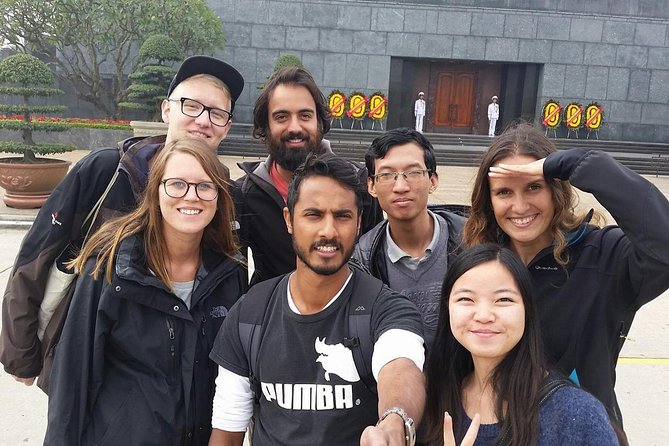
This is a good first look at Hanoi’s central historical sights because the stops are not random. They tell two connected stories. The Ho Chi Minh Complex explains the figure who led Vietnam through its independence struggle and later served as prime minister. The Temple of Literature takes you much further back, to Vietnam’s scholarly and Confucian traditions.
I like that the tour does not ask you to spend a full day on museums and monuments. In about three hours, you get a guided walk through several places that can feel disconnected if you visit them alone. A guide can explain why Ba Dinh Square matters, why Ho Chi Minh lived in a modest stilt house instead of the Presidential Palace, and why the Temple of Literature remains such a prized Hanoi sight.
The experience is led by an English-speaking local student. That matters more than it may sound. You are not simply being moved from one photo stop to the next. The strongest guide reports name Arthur, Linh Chi, Vy, Lily, and Hannah, with particular praise for clear explanations, good English, patience, and a friendly manner. The guide is the main reason to book rather than just follow the same route independently.
The $5 price looks almost too low, but remember the extra $4 entrance fee. Personal expenses, food, drinks, tips, and any transfer fees are also left out. Even with the added admission cost, the tour can be good value if you want historical context and help finding your way between sights.
A few other Hanoi trips to compare
- Hanoi Jeep Tour: Food, Culture and Fun by Vietnam Army Jeep
★ 5.0 · 15,222 reviews - Full-Day Ninh Binh Highlights Tour from Hanoi
★ 5.0 · 7,761 reviews - Hanoi: Ha Long Bay Day Cruise – Swimming, Meal, Kayaking
★ 4.7 · 7,415 reviews
Starting at Ba Dinh Square and the mausoleum
The tour begins at 19 P. Ngọc Hà, Đội Cấn, Ba Đình, Hanoi, at either 9:00 AM or 2:00 PM. The guide welcomes you there and takes you into the Ho Chi Minh Complex. The stated visit to the mausoleum lasts about 30 minutes, making it the longest stop in this first part of the tour.
Ba Dinh Square is the key setting. On September 2, 1945, Ho Chi Minh read Vietnam’s Declaration of Independence here. That event gives the square more weight than its broad open space and formal layout might suggest. Your guide can connect the place to the country’s political story, rather than leaving you with only a grand building and a few photographs.
The mausoleum itself is a solemn site dedicated to Ho Chi Minh. The tour description refers to the complex as a major construction expressing national pride. You should expect the stop to be more about historical importance and public memory than entertainment. This is a place where respectful behavior matters.
Admission is not included, and the supplied information lists entrance fees at $4 per person. The details do not break down which portion applies to each attraction, so budget the full amount rather than expecting the $5 booking price to cover everything.
Ho Chi Minh’s modest stilt house
The next stop is Ho Chi Minh’s Stilt House, scheduled for about 10 minutes. The contrast with the formal mausoleum is the point. Ho Chi Minh refused to live in the Presidential Palace and instead used a normal electrician’s house nearby.
The house has two floors, and Ho Chi Minh lived there from 1958 until his death. That small detail gives the stop its human scale. You are seeing the setting associated with a leader who chose a simpler home, not another grand official residence.
Ten minutes is brief, but it is probably enough for a short explanation and a look around. If you want an extensive study of Ho Chi Minh’s personal life, this tour will feel too quick. If you want the essential context while keeping the half-day schedule moving, the short visit works well.
The One Pillar Pagoda and its old legend
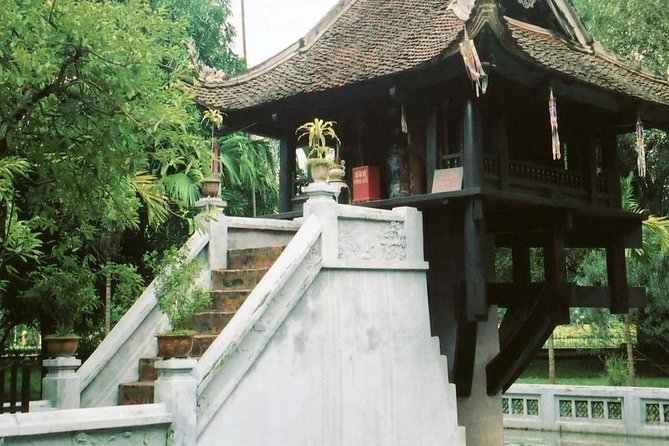
The One Pillar Pagoda is another short stop, listed at about 10 minutes. Built in 1049 under the Ly Dynasty, it carries a much older story than the nearby modern political sites.
The pagoda’s design and origin are tied to a legend involving King Ly Thanh Tong. The supplied information does not give the full version of the tale, so you should expect your guide to provide the details during the visit. This is one reason the tour format helps. A quick look at an unusual pagoda can mean little without an explanation of its age, royal connection, and religious role.
The stop is compact, so do not expect a long quiet visit. Think of it as a focused introduction to one of Hanoi’s distinctive historic structures. It also prepares you for the Temple of Literature later in the tour, where the emphasis shifts from royal religious architecture to education and Confucian thought.
Same base, a completely different day:
- Hanoi: Water Puppet Show Tickets
★ 4.6 · 7,029 reviews - Hanoi Motorbike Tour: Food, Culture and Fun by Vintage Motorbike
★ 5.0 · 6,699 reviews - Hanoi: Guided Food Tour with Train Street Visit
★ 4.9 · 6,239 reviews - Hanoi Cooking Class: Culture, Local Market & Meaning CSR Impact
★ 5.0 · 5,147 reviews
The Ho Chi Minh Museum’s lotus-shaped building
The Ho Chi Minh Museum receives about 20 minutes. The museum is designed in the shape of a white lotus and rises nearly 20 meters across three floors. More than 2,000 documents and objects are displayed there, arranged to reflect Ho Chi Minh’s life and political work.
Twenty minutes is enough for an orientation, but it is not enough for a careful museum visit. You will need to rely on your guide to point out the main themes and explain why the material matters. If you are especially interested in Vietnamese political history, you may wish you had more time inside.
That said, the museum adds useful depth to the outdoor stops. Ba Dinh Square tells you where a major event took place. The stilt house shows a personal setting. The museum provides documents and objects that help connect those pieces to Ho Chi Minh’s public life.
Linh Chi is specifically praised for good English and for paying attention to individual interests and preferences. That kind of guide can make a short museum visit much more useful, especially if you want to ask about political history rather than simply follow a standard speech.
The Temple of Literature, Hanoi’s scholarly heart
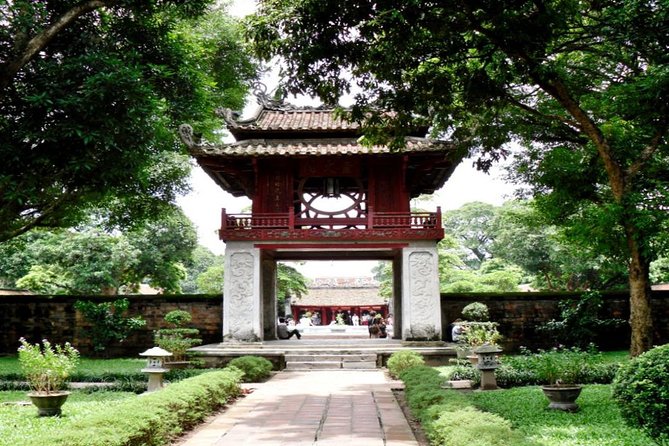
The final major stop is the Temple of Literature and National University, with about one hour set aside. This is the tour’s longest visit, and rightly so. The site was Vietnam’s first university and also serves as a place of worship for Confucius.
The Temple of Literature is often considered one of Hanoi’s most picturesque attractions. Its importance is not only visual. It introduces the educational ideals, scholarship, and Confucian values that shaped Vietnamese society across earlier dynasties.
After the political focus of the Ho Chi Minh Complex, the Temple of Literature changes the pace. You have more time to look at the courtyards and buildings, hear about the Ly and Tran dynasties, and understand why education held such a central place in traditional Vietnam. I like this pairing because it prevents the tour from becoming only a lesson about one modern leader.
A full hour gives you room to listen and look rather than rush through for a single photograph. Vy, who guided one highly praised visit, is noted for making the route easy, fun, and informative. Lily is also praised for explaining both the Presidential Complex and Temple of Literature clearly while offering further recommendations for Hanoi.
The tour ends back at the meeting point. That makes the Temple of Literature the final sightseeing stop, not a drop-off at another part of the city. Plan your next activity with that return in mind.
What the small group changes
The maximum group size is 12 people. That is small enough to feel more personal than a standard sightseeing group, though it is not a private tour. You may still need to wait for others at entrances or move at the group’s pace.
The local student guide is included. This is a useful arrangement for a site-heavy tour because a student guide may bring an approachable, less formal style. The strongest guide feedback centers on kindness, clear history explanations, helpfulness, and the feeling of spending time with a friendly local rather than hearing a stiff lecture.
The guide also helps with the connections between sites. The listed stops are close enough to form one sensible complex visit, but the historical links are not always obvious. A guide can explain why a square, residence, pagoda, museum, and university belong in the same Hanoi half-day.
There is one important caution. One reported booking involved a guide who did not arrive, followed by a delay in communication and a difficult refund process. This appears to be an isolated but serious service failure. I would keep the meeting details handy and confirm the starting time when possible, even though booking confirmation is provided at the time of purchase.
Choosing the morning or afternoon departure
You can choose a 9:00 AM or 2:00 PM start. The morning option leaves the rest of your day open, which is useful if you want to add another Hanoi sight, shop, or meal afterward. It also avoids using your afternoon for the tour.
The 2:00 PM option suits you if you prefer a slower morning or have other plans earlier in the day. Since the tour lasts about three hours, it occupies much of the afternoon and finishes around early evening, based on the stated duration.
The information does not promise a different itinerary for either time. Choose based on your schedule rather than expecting one departure to include extra stops. The experience requires good weather. If poor weather forces cancellation, you are offered another date or a full refund.
Price, admission, and what you actually receive
At $5 per person, this is priced more like a guided introduction than a full-service excursion. You are paying for the local English-speaking student guide and the organization of the visit. You are not paying for meals, drinks, personal expenses, tips, or transfer fees.
The extra $4 entrance fee is the most important price detail. Add it to the advertised cost when comparing this experience with other Hanoi tours. The final basic cost is still modest, but the low headline price can otherwise give you the wrong idea.
No hotel pickup is included in the information provided. The meeting point is 19 P. Ngọc Hà, Đội Cấn, Ba Đình, Hanoi, and the activity returns there. The tour is near public transportation, which helps, but the details do not specify a private vehicle or included transfers.
For the money, I think the value is strongest if you want interpretation. If you already know the history, speak with a local guide often, and are comfortable arranging the sights yourself, the paid tour may add less. If you are new to Hanoi, the explanations can make the $9 basic total worthwhile.
Who should book this experience
I would recommend this tour to first-time Hanoi visitors who want a compact introduction to Vietnam’s political and cultural past. It also suits anyone who prefers a small group, wants to ask questions, or does not want to work out the connection between six separate stops alone.
It is a good fit for you if you have only half a day available. The tour does not try to cover all of Hanoi. Instead, it concentrates on one district and two major themes: Ho Chi Minh’s legacy and Vietnam’s long scholarly tradition.
You should think twice if you need hotel transportation, dislike fixed group timing, or want long museum visits. The Ho Chi Minh Museum receives only about 20 minutes, and several other stops last just 10 minutes. You are getting a guided overview, not an in-depth museum day.
The tour is listed as suitable for most people, and the group maximum is 12. Specific accessibility details are not provided, so ask the operator directly if you have mobility or access needs.
Should you book the Ho Chi Minh Complex tour?
Book it if you want a low-cost, guided introduction to Hanoi’s most important historical sights and value a friendly local explanation more than a long, leisurely visit at each stop. The pairing of the Ho Chi Minh Complex with the Temple of Literature is the real strength, giving you a broader sense of Vietnam than either area alone.
Before paying, remember the $4 entrance fee, the meeting point, the return to that same point, and the strict non-refundable policy. Choose the departure that fits your day, allow for good weather, and confirm the meeting arrangements.
The occasional guide-arrival problem is worth noting, but the overall rating is 4.8 from 42 reviews, with 95 percent recommending the experience. I would book this as a practical first Hanoi tour, especially if Arthur, Linh Chi, Vy, Lily, or Hannah is assigned and you want history explained in plain English rather than left to a signboard.
FAQ
Where does the tour start?
The tour starts at 19 P. Ngọc Hà, Đội Cấn, Ba Đình, Hà Nội 11113, Vietnam.
Where does the activity end?
The activity ends back at the meeting point.
What departure times are available?
You can choose a 9:00 AM or 2:00 PM start, depending on your booking.
How long does the tour last?
The tour lasts approximately three hours.
What is included in the tour?
An English-speaking local student is included.
Are entrance fees included?
No. Entrance fees are listed separately at $4 per person.
What happens if bad weather cancels the tour?
If poor weather causes cancellation, you will be offered a different date or a full refund.
Newly listed around Hanoi
- Hanoi: Halong Bay Cruise, Amazing Cave, Titov Island & Kayak★ 4.2 · 39 reviews
- Ninh Binh 1 Day Tour(Tam Coc – Mua Cave – Bich Dong)★ 5.0 · 39 reviews
- 2Days-1Night Halong Bay Luxury Genesis Regal Cruises★ 4.5 · 39 reviews
- 8 days 360° Vietnam Adventure from Hanoi★ 5.0 · 39 reviews
- Dora Cruise – Luxury 5 Star Cruise in Halong Bay & Lan Ha Bay (2D1N)★ 4.5 · 39 reviews
- 3 Days and 2 Nights Ha Giang Loop Tour★ 5.0 · 39 reviews
- Best Value Ha Long bay 1 day – Lunch, kayak, swimming, transfer★ 5.0 · 39 reviews
- From Hanoi: Ha Giang Loop Motorbike Tours 3-Days 2-Nights★ 5.0 · 40 reviews
Hanoi Tours, compared.

Hanoi Jeep Tour: Food, Culture and Fun by Vietnam Army Jeep
Read our review →
Full-Day Ninh Binh Highlights Tour from Hanoi
Read our review →
Ha Long Bay Day Cruise – Swimming, Meal, Kayaking
Read our review →

Hanoi Motorbike Tour: Food, Culture and Fun by Vintage Motorbike
Read our review →

Hanoi Cooking Class: Culture, Local Market & Meaning CSR Impact
Read our review →