
Reviewed · HANOI TOURS
Hanoi: Centuries of Highlights in 1 Hour by Open-Top Bus
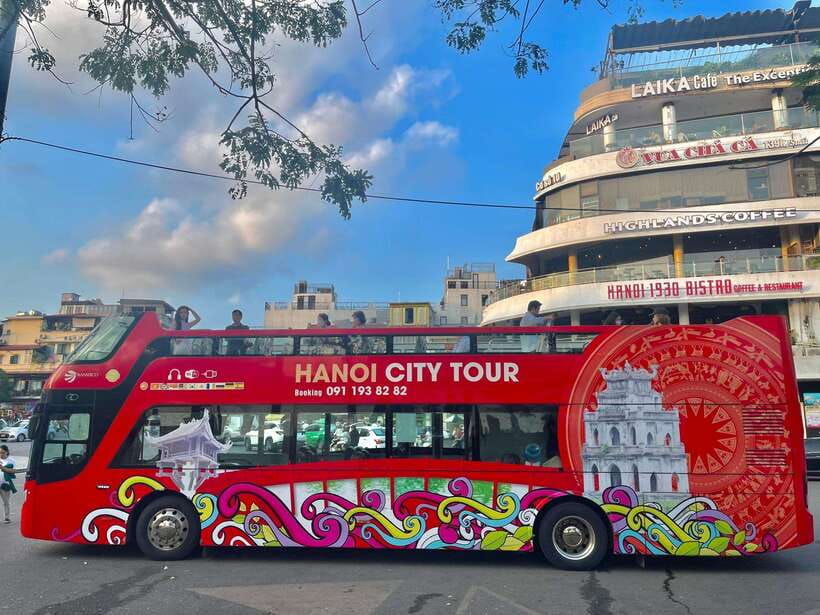
Hanoi’s story comes at you quickly on this one-hour open-top bus ride, from the crowded lanes around Hoan Kiem Lake to the broad ceremonial space of Ba Dinh Square. You pass more than 20 sights without stopping, including the Temple of Literature, Hoa Lo Prison, Hanoi Flag Tower, and the Ho Chi Minh Complex.
I like the high seating, which gives you a better view over traffic and makes it easier to spot buildings as the bus rolls by. I also like the low price, free water, city map, raincoat, Wi-Fi, and choice of day or night departure. The main drawback is clear: this is a non-stop loop, and the audio guide has sometimes been out of sync or hard to hear.
Key points before you board
- A fast first look at Hanoi: The complete loop takes about one hour and covers the city center’s main landmarks.
- Open-top views: The upper deck gives you a useful view of buildings, squares, lakes, and passing street life.
- No hop-on, hop-off privilege: You can board once, but you cannot get off and rejoin the route.
- Eight audio languages: English, French, German, Spanish, Russian, Japanese, Korean, and Vietnamese are available.
- Simple extras included: You receive water, a map, a conical hat, a raincoat, Wi-Fi, and bus insurance.
- A few practical limits: Oversize luggage, baby strollers, mobility scooters, non-folding wheelchairs, bikes, and smoking are not allowed.
What this one-hour Hanoi route really gives you
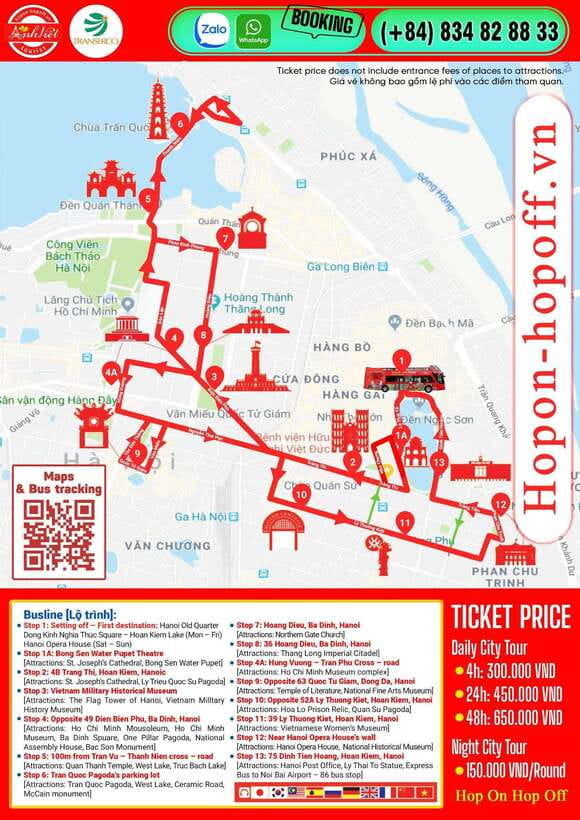
I see this tour as a moving introduction rather than a full sightseeing day. You will not enter the monuments, pause for photographs at every landmark, or explore the Old Quarter on foot. Instead, you get a quick visual guide to Hanoi’s main districts and a way to decide where you want to return later.
The bus passes more than 20 notable places, with the route ending at the Hanoi Opera House. That final location is useful. You can continue on foot into central Hanoi, find a meal, walk toward the lake, or visit another attraction nearby.
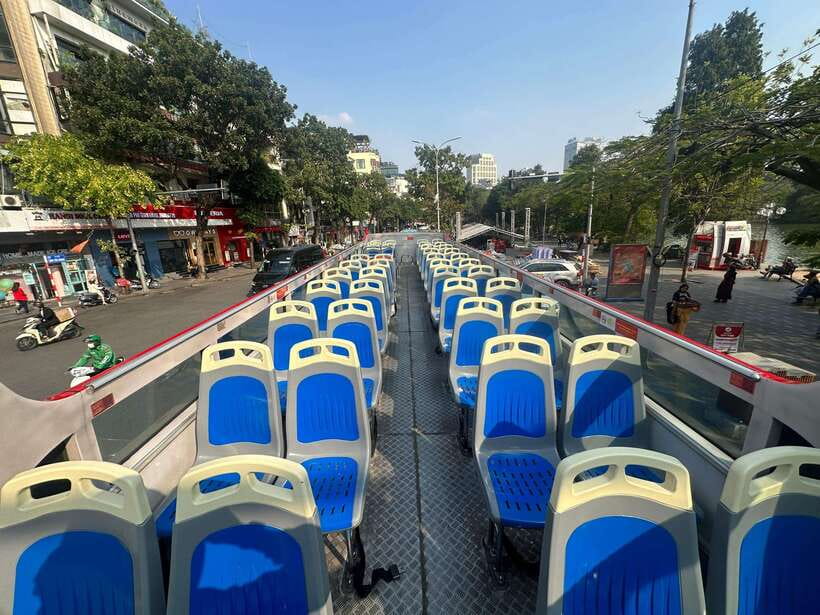
The open roof matters here. Hanoi’s streets are crowded, and from the top deck you can see over some of the traffic and notice details that are easy to miss from a car. The tradeoff is exposure to sun and rain. A free conical hat and raincoat are supplied, but I would still check the weather before choosing the upper deck.
At $7 per person, the tour offers reasonable value if you want orientation, not admission to attractions. You are paying for transport around the central sights, commentary, and a city map. Entrance fees, food, drinks, hotel transfers, and personal tourism insurance are not included.
A few other Hanoi trips to compare
- 1 Hour Saigon River Tour in Ho Chi Minh
★ 4.5 · 418 reviews - One Hour Spa Experience in Hoi An
★ 5.0 · 189 reviews - 1-Hour Lantern Making Class in Hoi An
★ 5.0 · 106 reviews
Starting at Dong Kinh Nghia Thuc Square
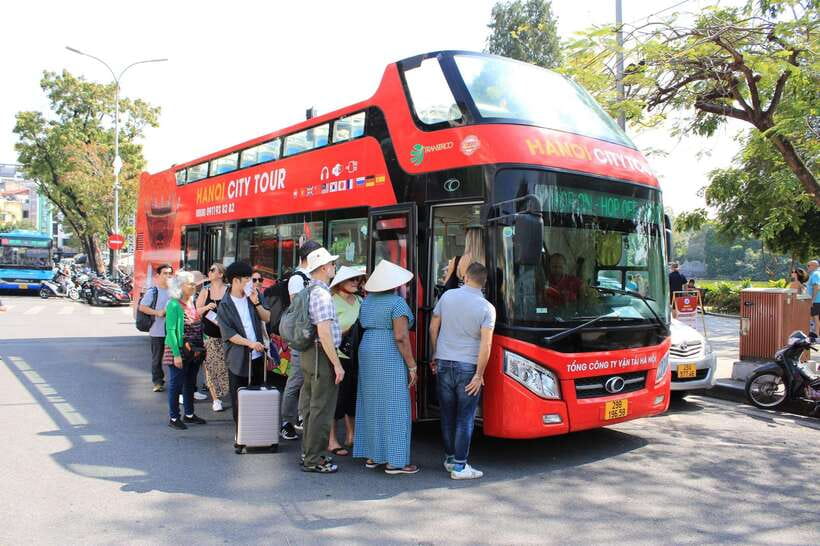
From Monday through 7:00 pm on Friday, the main meeting point is Dong Kinh Nghia Thuc Square at 7 Dinh Tien Hoang. Look for the red double-decker Hanoi City Tour ticket booth.
One practical detail deserves attention. You may need to exchange or validate your barcode or ticket at the counter by the lake before boarding. One booking experience described the actual bus meeting point as about 300 meters from the counter. I would arrive early enough to locate both places, especially if you are working with a tight schedule.
The bus runs from 8:30 am to 9:30 pm Monday through Thursday. From Friday through Sunday, service runs from 8:30 am to 8:00 pm. Buses are scheduled every 30 minutes, although traffic, public holidays, weather, and road closures can change the timing.
From 7:30 pm on Friday, and throughout Saturday and Sunday, pickup is at the Hanoi Opera House instead. Check your selected time and meeting point carefully. A booking made for the wrong evening may not be easy to fix at the last minute.
Hoan Kiem Lake and the Old Quarter
Hoan Kiem Lake is the natural opening point for understanding central Hanoi. It sits beside the Old Quarter, where narrow streets, shops, cafés, and constant scooter traffic create the city’s most concentrated urban scene.
From the bus, you get a broad look rather than a close study. The upper deck helps you see the lake, surrounding streets, and the changing mix of old buildings and newer commercial fronts. I like this part of the route for orientation. Afterward, you will have a clearer sense of how the lake relates to the Old Quarter and the city center.
The bus does not turn this into a walking tour. If you want the small details, street food, temples, and shop-house lanes, you will need to return on foot. Think of the ride as a map in motion.
Saint Joseph Cathedral and the city’s older streets

Saint Joseph Cathedral introduces another side of central Hanoi. Its presence reflects the city’s French colonial period, and its location places it within easy reach of the Old Quarter.
The bus gives you a passing view, so you should not expect time for a quiet look inside or a careful architectural inspection. Still, seeing the cathedral from the upper deck helps you connect several central areas in a short time.
The audio commentary is meant to explain the landmarks as you pass them. It is offered in English, French, German, Spanish, Russian, Japanese, Korean, and Vietnamese. That range is useful for mixed-language groups, but the equipment is not always perfect. Sound may crackle, and the narration can occasionally lag behind the building you are seeing.
Same base, a completely different day:
- Hanoi Jeep Tour: Food, Culture and Fun by Vietnam Army Jeep
★ 5.0 · 15,222 reviews - Full-Day Ninh Binh Highlights Tour from Hanoi
★ 5.0 · 7,761 reviews - Hanoi: Ha Long Bay Day Cruise – Swimming, Meal, Kayaking
★ 4.7 · 7,415 reviews - Hanoi: Water Puppet Show Tickets
★ 4.6 · 7,029 reviews
Ba Dinh Square and the Ho Chi Minh Complex

The route then reaches the broad area around Ba Dinh Square and the Ho Chi Minh Complex. This is a sharp change from the tight streets around the lake. The open space gives you a better sense of Hanoi as Vietnam’s political capital.
The Ho Chi Minh Mausoleum is among the most important sights on the route. You pass it rather than enter, so the value here is visual context. The bus lets you take in the scale of the square and the placement of the complex without spending time in queues.
I especially like this section for first-time visitors because it shows how different Hanoi’s districts feel. The Old Quarter is compact and crowded. Ba Dinh is formal, spacious, and arranged around major national buildings.
The route also includes the Hanoi Flag Tower, a landmark linked to the Imperial Citadel area. From the bus, it becomes part of a larger picture of the capital’s military and political center.
Quan Thanh Temple and Tran Quoc Pagoda

Quan Thanh Temple and Tran Quoc Pagoda bring religious landmarks into the circuit. Both help broaden the tour beyond colonial buildings and government sites.
Quan Thanh Temple is associated with Hanoi’s older spiritual traditions. Tran Quoc Pagoda sits by West Lake and is one of the city’s best-known Buddhist sites. Passing these places from an open-top bus gives you a useful sense of the city’s water-side setting and its long religious identity.
Again, the route is observational. You cannot get off to inspect the pagoda grounds or temple details. If either place interests you, mark it on your map and plan a separate visit. The supplied city map is handy for this kind of follow-up.
Cua Bac Church and the Imperial Citadel of Thang Long
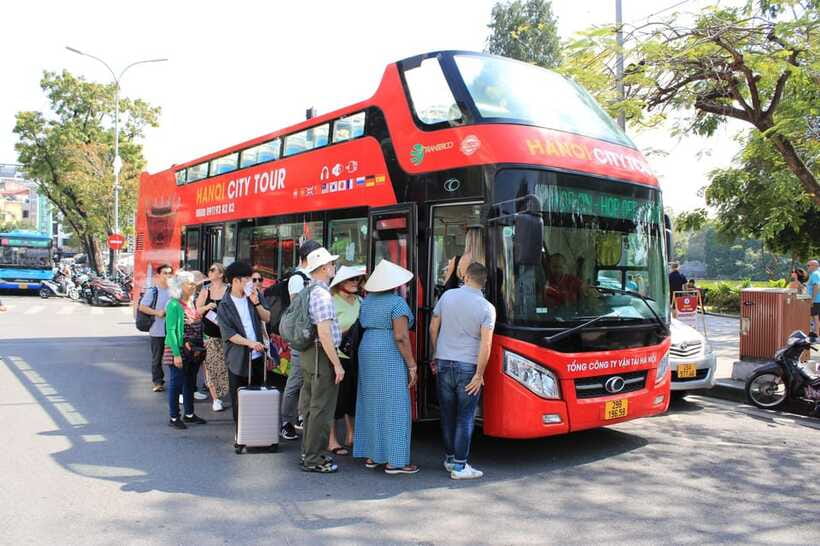
Cua Bac Church continues the route’s mix of religious and historic landmarks. Its inclusion alongside temples, pagodas, and the cathedral gives you a quick reminder that Hanoi’s built environment comes from several periods and traditions.
The Imperial Citadel of Thang Long is one of the most important historic areas on the circuit. It represents the old center of political power in Hanoi and helps explain the city’s claim to more than a thousand years of history.
The bus cannot offer the same understanding as walking through the citadel grounds. However, it does something useful for a short visit: it shows you where the citadel sits in relation to Ba Dinh Square and the surrounding capital. I would use this part of the tour to choose whether the citadel deserves a longer return visit.
Temple of Literature and Hoa Lo Prison
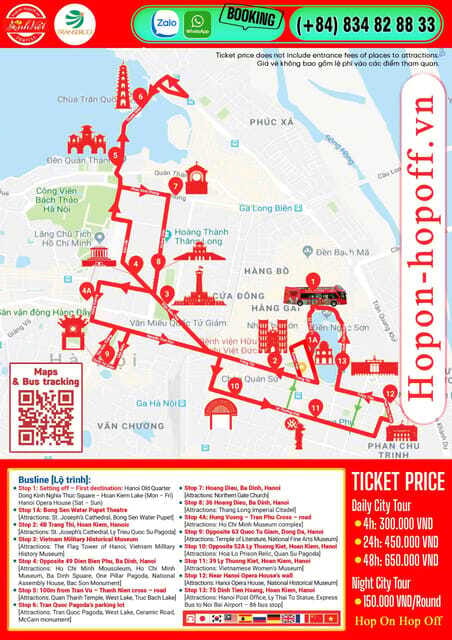
The Temple of Literature is one of Hanoi’s most memorable cultural landmarks. Its name points to learning, scholarship, and Vietnam’s long educational traditions. From the bus, you see the exterior setting and hear a short explanation through the audio guide, but the courtyard details will pass quickly.
Hoa Lo Prison offers a much heavier historical stop. It is linked to Vietnam’s colonial period and later wartime history. A passing view cannot convey the full weight of the site, but seeing it on the route can help you decide to return for a proper visit.
These two places show the limits and usefulness of the bus. You receive a broad introduction to major sites, but you do not get enough time for the kind of careful attention that museums and historic compounds require. For me, that is not a flaw if you treat the tour as a first survey.
Women’s Museum, Opera House, and the final stop
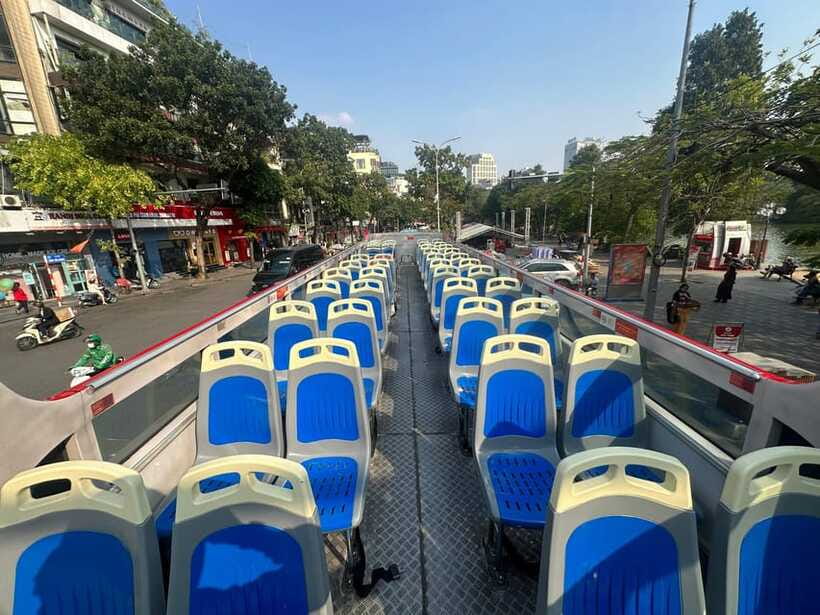
The Vietnam Women’s Museum adds a social and cultural focus to the route. It is different from the royal, military, religious, and government sights seen earlier. The bus passes the museum, giving you another possible stop for your own itinerary.
The Hanoi Opera House brings the loop back toward the central city. Its elegant exterior makes a fitting final landmark, and the tour concludes there. This is more useful than ending in an out-of-the-way area because you can continue exploring immediately.
You might use the finish to walk back toward Hoan Kiem Lake, find lunch or dinner, or visit another central sight. The exact next step depends on your plans, but the location gives you options rather than forcing an extra taxi ride.
The audio guide: helpful idea, uneven delivery
The multilingual audio guide is included, and that makes the $7 fare more attractive. You can choose from eight languages, including English, French, German, Spanish, Russian, Japanese, Korean, and Vietnamese. The commentary is intended to explain what you are seeing without requiring a live guide.
I would keep your expectations moderate. Audio quality has been inconsistent. At times, the sound may crackle or outside noise may make it hard to hear. The narration may also be a little ahead of or behind the landmark outside the bus.
That timing problem matters on a one-hour, non-stop route. If the commentary names a building after you have passed it, you may miss the connection. I suggest looking out first and treating the audio as a bonus rather than your only source of information.
There are no guide names supplied for this experience. The service relies on recorded multilingual commentary rather than a named personal guide.
Seating, comfort, and what to bring
A clean bus and a comfortable ride are important on a short city circuit. The upper deck gives you the best sightlines, but it also leaves you exposed to Hanoi’s weather. The free conical hat helps with sun, while the raincoat is useful during a sudden shower.
Free water is a thoughtful touch, especially in warm conditions. Wi-Fi is included, along with a city map. Bus insurance is included, but that is not the same as personal tourism insurance, which you would need to arrange separately.
The vehicle is wheelchair accessible, but non-folding wheelchairs are not allowed. Mobility scooters are also prohibited. You cannot bring oversize luggage, baby strollers, bikes, or other bulky items. Smoking, chewing gum, alcohol, drugs, and food or drinks inside the vehicle are not permitted.
Why the non-stop format matters
This is not a hop-on, hop-off ticket in the usual sense. You have one ride during the pass capacity, and if you get off, you cannot board again.
That rule changes how you should plan. Do not board expecting to jump off at the Temple of Literature and rejoin later. If you want to visit a landmark, use the bus to preview it, finish the loop, and return independently.
The fixed format is also what keeps the tour to one hour. You see more sites because nobody is getting on and off at each stop. I find that useful when time is short, but less useful if your main goal is detailed sightseeing.
Day tour or evening ride?
The operating hours give you a choice. Daytime rides are better for reading buildings, seeing the lake, and following the route on the map. They also make it easier to notice details at landmarks such as the Flag Tower, cathedral, and Opera House.
An evening ride gives you a different view of Hanoi’s central streets. You may prefer the cooler air and city lights, but the commentary and architecture may be harder to follow in the dark. Friday evening pickup moves to the Hanoi Opera House from 7:30 pm, and weekend pickup is also there.
Because buses run every 30 minutes, you have some flexibility. Still, the schedule can shift because of traffic, road closures, holidays, or weather. I would not use this tour as the only way to reach an important appointment.
Who gets the best value for $7?
I think the fare works best for three kinds of people:
- First-time visitors: You get a quick mental map of central Hanoi before choosing where to spend more time.
- Short-stay visitors: One hour covers a lot of ground without committing half a day.
- Families or mixed-interest groups: The bus lets everyone see major landmarks together, with water, a map, and multilingual audio included.
The value is weaker if you want entry to monuments, a walking guide, or detailed explanations at each sight. You will pay extra for admissions and still need separate transport if you get off to explore.
The 3.8 rating from 101 reviews fits the practical picture. The route, bus cleanliness, height, and coverage are useful strengths. The audio faults and confusion over the ticket counter or meeting point are the main concerns. At this price, I would book for the route and views, not for polished guiding.
Booking and boarding tips that save trouble
I would choose the meeting point carefully when booking. From Monday morning through Friday at 7:00 pm, use Dong Kinh Nghia Thuc Square at 7 Dinh Tien Hoang. From 7:30 pm Friday, plus Saturday and Sunday, use the Hanoi Opera House.
Show your paper or mobile ticket to staff when you board. If you have a barcode, allow time to check whether it must be exchanged at the lake-side counter first.
Arrive with a small bag. Oversize luggage and strollers are not permitted, and the bus is not designed for bulky belongings. If you need a non-folding wheelchair or use a mobility scooter, this is not the right vehicle.
Free cancellation is available up to 24 hours before departure for a full refund. You can also reserve now and pay later, which helps if your Hanoi schedule is still changing.
Should you book this Hanoi bus tour?
Book it if you want a cheap, fast overview of Hanoi and understand that you will stay on the bus for the full loop. The views from the upper deck, the broad list of landmarks, and the convenient Opera House finish make it a sensible first activity.
Skip it if you want to enter attractions, walk through the Old Quarter, or depend on perfectly timed commentary. The audio guide can be difficult to hear or slightly out of step with the sights.
My practical choice would be to take it early in your stay, then return to two or three places that catch your attention. At $7, it is a modest way to get oriented, provided you treat it as a moving introduction rather than the complete Hanoi experience.
FAQ
How long does the Hanoi open-top bus tour last?
The complete loop lasts approximately one hour.
Is this a hop-on, hop-off tour?
No. It is a non-stop bus tour. You can board once during the pass capacity, and if you get off, you cannot get back on.
Where is the meeting point?
From Monday through 7:00 pm Friday, meet at Dong Kinh Nghia Thuc Square, 7 Dinh Tien Hoang, near the red double-decker bus ticket booth. From 7:30 pm Friday, and on Saturday and Sunday, pickup is at the Hanoi Opera House.
What time does the bus operate?
The service runs from 8:30 am to 9:30 pm Monday through Thursday. From Friday through Sunday, it operates from 8:30 am to 8:00 pm. Buses are scheduled every 30 minutes.
Which languages are available for the audio guide?
The audio guide is available in Chinese, English, German, Japanese, Korean, French, Spanish, and Vietnamese.
Is the bus wheelchair accessible?
The bus is wheelchair accessible, but non-folding wheelchairs and mobility scooters are not allowed.
What is included in the ticket?
The ticket includes one Hanoi city tour bus ride, a city map, free water, a conical hat, a raincoat, Wi-Fi, the multilingual audio guide, and insurance on the bus.
Can I cancel or pay later?
You can cancel up to 24 hours in advance for a full refund. Reserve now and pay later is also available.
Newly listed around Hanoi
- Hanoi: Halong Bay Cruise, Amazing Cave, Titov Island & Kayak★ 4.2 · 39 reviews
- 2Days-1Night Halong Bay Luxury Genesis Regal Cruises★ 4.5 · 39 reviews
- Ninh Binh 1 Day Tour(Tam Coc – Mua Cave – Bich Dong)★ 5.0 · 39 reviews
- 8 days 360° Vietnam Adventure from Hanoi★ 5.0 · 39 reviews
- Dora Cruise – Luxury 5 Star Cruise in Halong Bay & Lan Ha Bay (2D1N)★ 4.5 · 39 reviews
- 3 Days and 2 Nights Ha Giang Loop Tour★ 5.0 · 39 reviews
- Best Value Ha Long bay 1 day – Lunch, kayak, swimming, transfer★ 5.0 · 39 reviews
- From Hanoi: Ha Giang Loop Motorbike Tours 3-Days 2-Nights★ 5.0 · 40 reviews
Hanoi Tours, compared.

Hanoi Jeep Tour: Food, Culture and Fun by Vietnam Army Jeep
Read our review →
Full-Day Ninh Binh Highlights Tour from Hanoi
Read our review →
Ha Long Bay Day Cruise – Swimming, Meal, Kayaking
Read our review →

Hanoi Motorbike Tour: Food, Culture and Fun by Vintage Motorbike
Read our review →

Hanoi Cooking Class: Culture, Local Market & Meaning CSR Impact
Read our review →
5 Traditional Dishes Hanoi Cooking Class with Market Trip
Read our review →Browse the lists this tour appears in