
Reviewed · HUE TOURS
Hue Customizable Tour with Imperial Citadel & Forbidden City
Hue’s Imperial Citadel is not just a grand gate and a few old halls. It is a carefully planned royal world where emperors held ceremonies, worshipped ancestors, managed the court, and kept their families and servants close at hand. The Forbidden Purple City brings the most human part of that story to life, with its former world of queens, minor wives, concubines, and eunuchs.
I like the choice between a focused 2.5-hour walking tour and a longer private-car outing. I also like the guides’ clear, friendly style, especially names such as Misa, Ha, Duy, Nhi, and Nhien, who explain symbolism as well as dates and names. The main catch is that entrance tickets are not included, and the private-car driver is not a licensed guide.
Key points
- Walk through the royal heart of Hue: See the Nine Holy Cannons, Noon Gate, Flag Tower, Supreme Harmony Palace, Nine Dynastic Urns, ancestral temples, and Forbidden Purple City.
- Expect strong local storytelling: Guides explain Nguyen emperors, court customs, Confucian ideas, Feng shui, Buddhism, and the meaning of animals and numbers in the architecture.
- Choose your pace and scope: The walking option lasts about 150 minutes, while private-car trips can run from about 2.5 to 8 hours.
- Use the car option for a wider day: Add Thien Mu Pagoda, Minh Mang Tomb, Tu Duc Tomb, Khai Dinh Tomb, or Thuy Tien Abandoned Water Park.
- Plan for extra costs: Imperial City admission is listed at 200,000 Vietnamese dong for an adult, with combo tickets available for the city and royal tombs.
- Start early in hot weather: Much of the Citadel visit takes place outdoors, and an 8:30 a.m. start can be more comfortable than the afternoon.
Why Hue’s royal city needs a guide
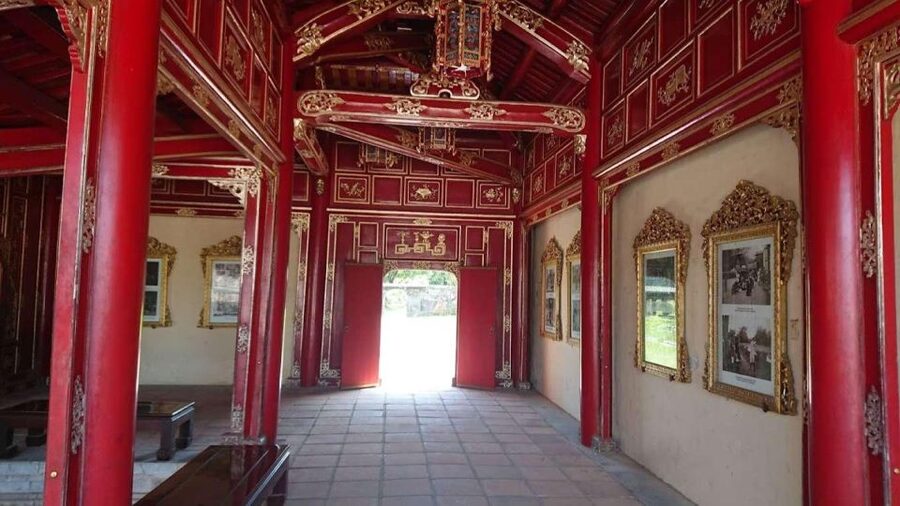
You can walk through the Citadel alone and admire its gates, gardens, courtyards, and restored buildings. But the site is large, and the meaning of each space is not always obvious. A guide turns a series of attractive buildings into a story about authority, ritual, family, and survival.
The walking tour concentrates on the Imperial Citadel and Forbidden Purple City. That makes it a good choice if you have limited time in Hue, or if you want the site explained without spending a full day in a car.
I especially value the way the guides connect architecture with ideas. Misa, for example, has explained links between Confucianism, Buddhism, Feng shui, numbers, and symbolic animals. That kind of context helps you understand why a building was placed in a certain position, or why a decorative detail matters.
The experience is also personal in a useful way. Guides such as Ha, Nhi, Linh, Nhien, and Duy are described as warm, approachable, and happy to answer questions. Several have adjusted the pace for heat, rain, photo stops, and independent looking. That matters in a place where rushing from one palace to the next can make the visit blur together.
More City Tours in Hue
- Hue :Exploring Royal City with Multi Options and Dragon Boat
★ 5.0 · 675 reviews - Hue City Tour Full Day – Group Tour
★ 4.7 · 518 reviews - Hue Imperial Ancient City Walking Tour
★ 4.8 · 308 reviews
Meeting at the four bronze cannons
For the walking option, you meet the guide at the four bronze cannons near Ngan Gate, also called Cua Ngan. Your guide holds an A4 sheet with your name, which should make the meeting simple.
Pay attention to the wording here. There are five cannons on the opposite side, so do not assume every cannon group is the meeting point. The pickup is not a hotel pickup for the walking tour.
The cannons are part of the story before the formal tour even begins. Hue artisans cast the nine Holy Cannons in 1803, during the second year of Emperor Gia Long’s reign. They were later moved to their current position during the reign of Emperor Khai Dinh. They are both weapons and works of bronze art, a reminder that the Nguyen court treated military power as part of its public image.
You spend roughly 15 minutes here, including explanation, photographs, and a first look at the Citadel surroundings. It is a calm way to get oriented before entering the main royal complex.
From Flag Tower to Noon Gate
The Flag Tower rises from the south side of the Citadel, within the Nam Chanh fortress. It was used to display the royal flag, and its location gives you an immediate sense of the Citadel’s defensive plan.
The stop is short, about five minutes in the suggested schedule, so you should think of it mainly as a photo and orientation point. The guide can explain how the tower fits into the walls and approach to the main gate.
Next comes Noon Gate, or Ngo Mon, the grand south entrance to the Imperial City. Built in 1833 under Emperor Minh Mang, it was used for ceremonies and troop movements. This is one of the places where scale and symbolism work together: the gate was not simply a way in, but a public stage for royal authority.
You have about 15 minutes here. Take time to look at the layered roof, the openings, and the broad approach. Your guide can help separate what was used for daily movement from what was reserved for formal occasions.
Supreme Harmony Palace and the royal center
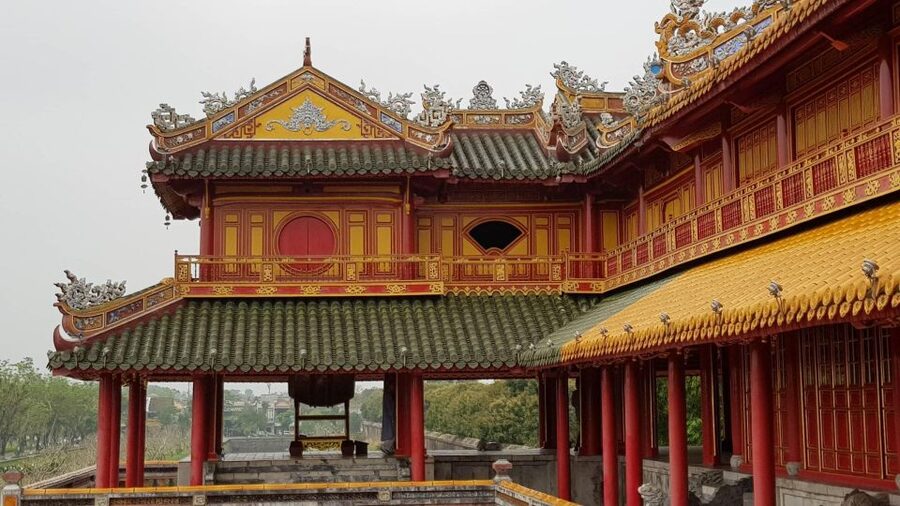
The Supreme Harmony Palace, or Thai Hoa Palace, is one of the main stops. Thirteen Nguyen emperors, from Gia Long to Bao Dai, used this palace for coronation ceremonies. In a monarchy shaped by ceremony, this was the symbolic center of the state.
The tour allows about 15 minutes at the palace, though your exact timing may vary. The building is valuable not only for its appearance, but for the way it shows how architecture controlled movement and attention. The open space before it helped turn a royal event into a carefully managed display.
This is a good point to ask questions about the emperors rather than only the buildings. The experience places real attention on court life, including the roles of queens, minor wives, concubines, and eunuchs. That gives the Forbidden City a more human, and sometimes uncomfortable, dimension.
A few other Hue Vietnam trips to compare
- From Da Nang/Hoian/Hue: Hue Imperial City Full-Day Tour
★ 4.8 · 295 reviews - Hue Imperial City Walking Tour: Citadel & Forbidden City
★ 4.8 · 245 reviews - Hue City Tour Full day – Small group tour
★ 4.7 · 137 reviews - Hue: City Sightseeing Hop-On Hop-Off Bus Tour
★ 3.7 · 63 reviews
Hien Lam Pavilion and the Nine Dynastic Urns
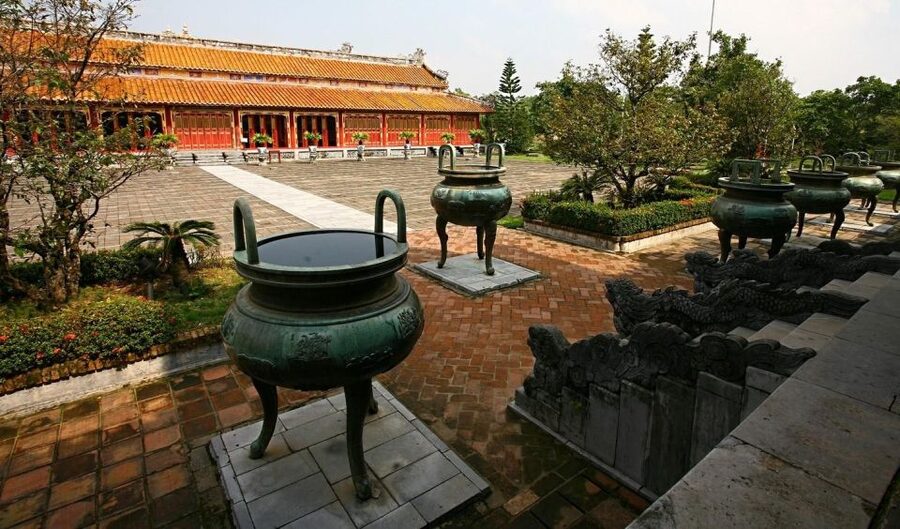
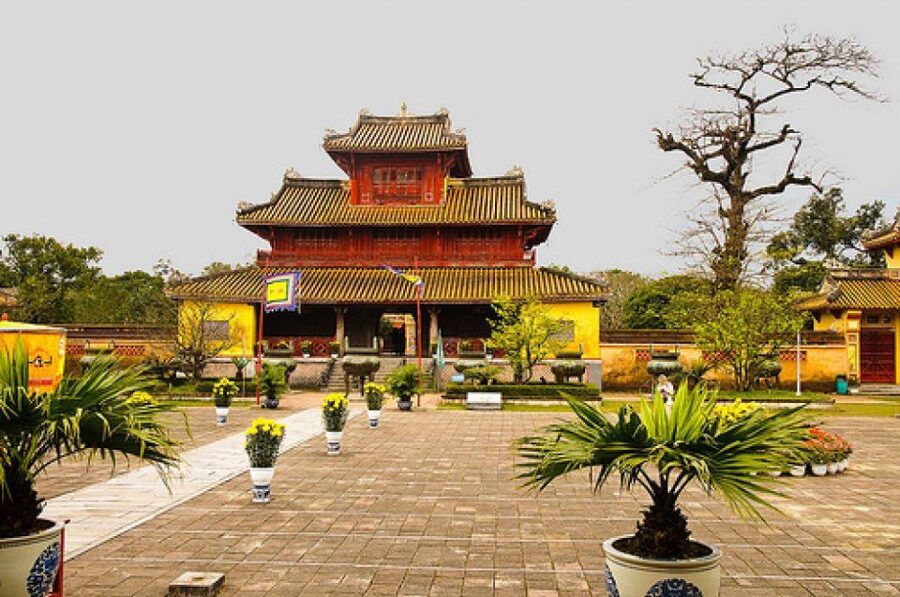
Hien Lam Pavilion is included among the central stops, followed by the Nine Dynastic Urns. The pavilion and urns sit near The Mieu, the ancestral temple complex, and together they show how the Nguyen dynasty presented its own past.
Emperor Minh Mang commissioned the nine bronze urns in 1835. They were completed and inaugurated in 1837. Each urn carries symbolic importance, and the guide can explain the links between the objects, the dynasty, and the wider idea of an ordered kingdom.
You have around 15 minutes for the urns. This is one of the spots where a guide adds real value because the details can otherwise look like decoration. The explanations about symbols, animals, numbers, and royal ideals help you read the objects rather than simply photograph them.
The nearby Hien Lam Pavilion and temple areas also reward a slower look. Your guide may point out how ancestor worship fitted into court life and why these buildings were placed together. The focus shifts here from the living emperor to the dynasty’s official memory.
Temples, urns, and the politics of ancestry
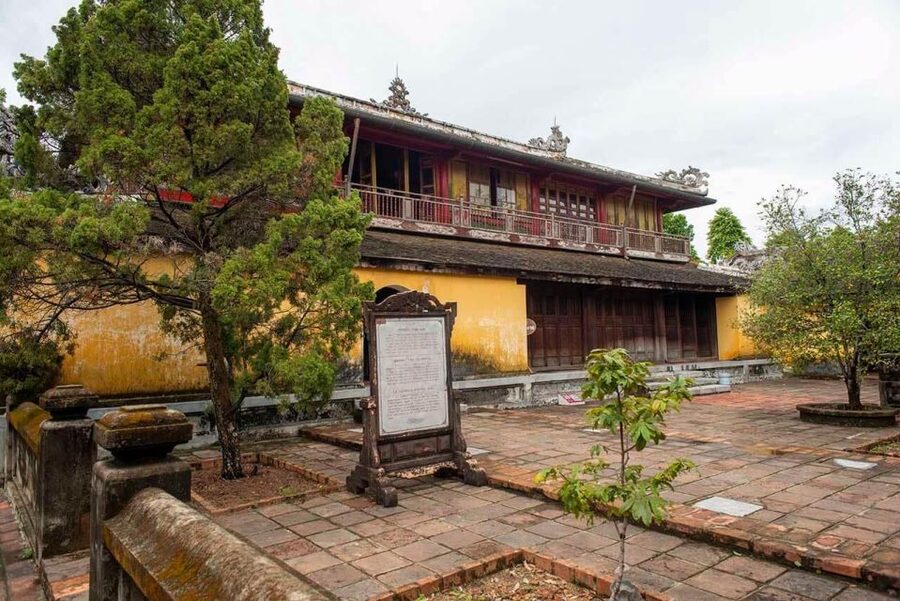
The suggested route includes Hung To Mieu, Hung Mieu, and Trieu To Mieu. These temple stops are shorter, often five to ten minutes, but they add useful depth to the visit.
The Mieu, also called The To Mieu, was built in 1821 by Emperor Minh Mang. It is a temple for ten Nguyen kings. This was not a private family shrine hidden from public life. It was part of the ceremonial structure that helped the dynasty claim legitimacy.
I find these stops especially useful if you want more than a collection of palaces. The temples show how the court linked living power with ancestors, ritual, and continuity. Some visitors may prefer to spend more time at the major gates and palaces, so tell your guide if you want longer photo breaks or more background at the temple buildings.
Entering the Forbidden Purple City
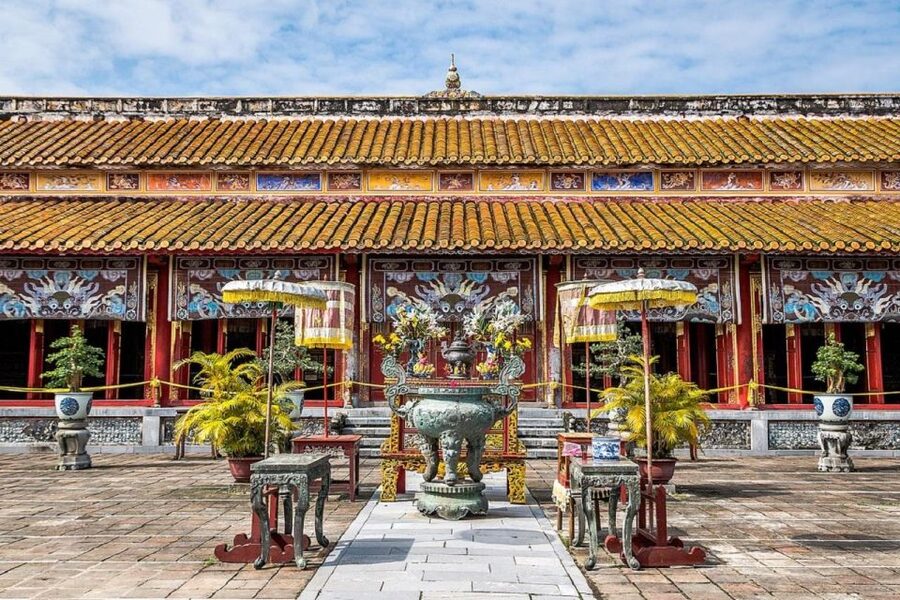
The Forbidden Purple City was the private center of royal life. Emperor Gia Long began building it in 1804, and Emperor Minh Mang renamed it in 1822. Located behind the Supreme Harmony Palace, it was once reserved for the emperor and his household.
This is the part of the tour that gives the Citadel its strongest personal drama. Behind the formal throne rooms was a controlled world of domestic life, court relationships, servants, and strict access. Learning about emperors alongside their wives, concubines, and eunuchs makes the complex feel less like a set of ceremonial buildings and more like a working household shaped by rank.
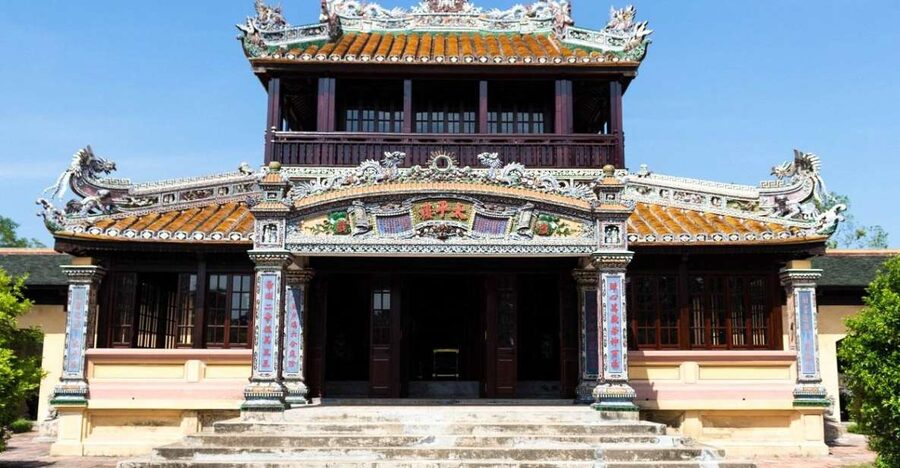
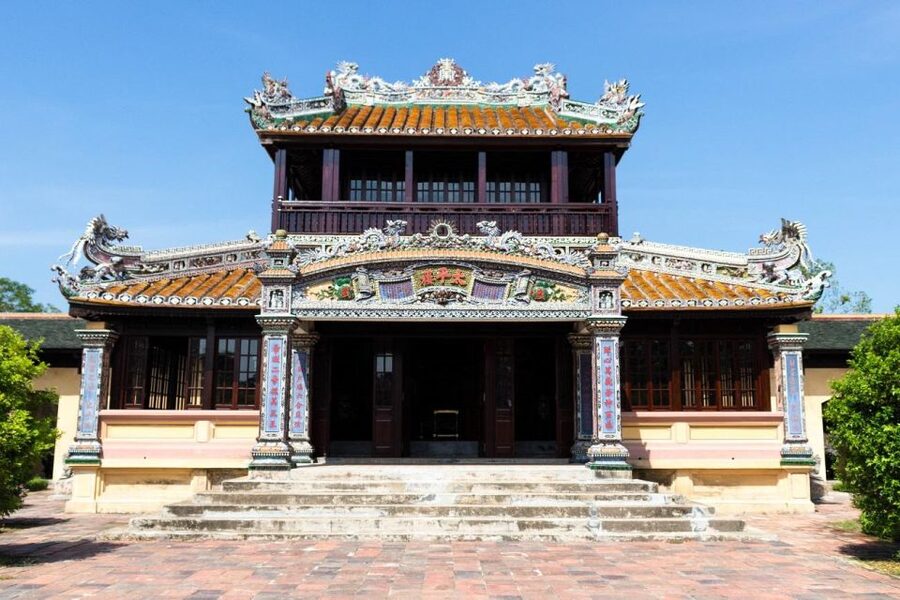
The route can include Dai Noi, the central Imperial City area, and about two hours in and around the larger complex. It may also pass or stop at former palace areas such as Kien Trung Palace, Thai Binh Pavilion, Thieu Phuong Garden, and Duyet Thi Duong Royal Theater.
Kien Trung Palace is listed as a short stop of about ten minutes. Thai Binh Pavilion and Thieu Phuong Garden each receive roughly 15 minutes. These locations help you picture the quieter side of court life, away from the throne and public ceremonies.
Duyet Thi Duong, the royal theater, adds another useful layer. Court life included performance and leisure, but these were still shaped by royal rules and ceremony. Ask your guide how entertainment fitted into the imperial schedule if that interests you.
Not every structure has survived intact. Parts of the Citadel were damaged during wartime, and much of what you see has been restored or reconstructed. That does not make the site unimportant, but it does mean you should view it as a place marked by loss as well as preservation.
A private car for tombs and pagodas
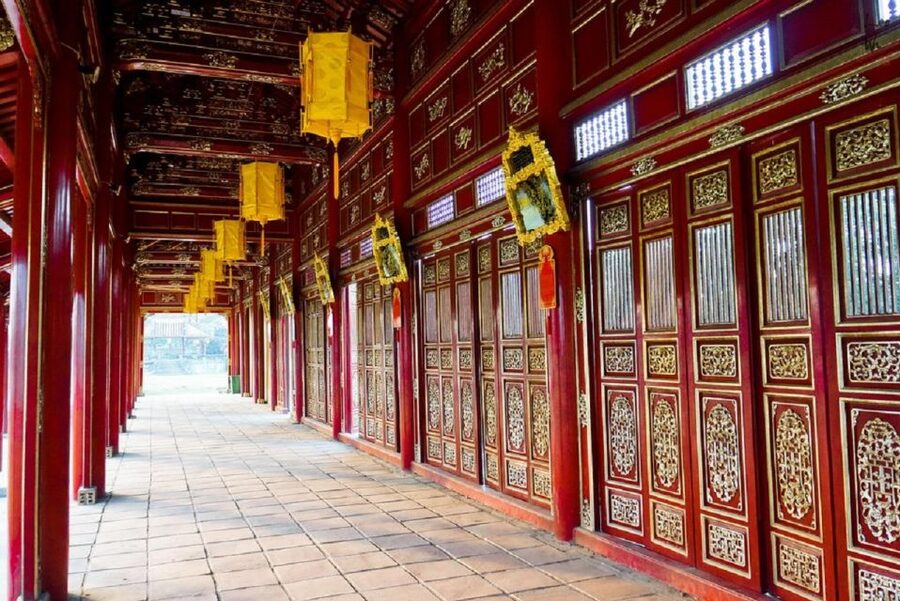
The private-car option changes the nature of the day. An English-speaking driver can collect you from a city-center hotel or Hue Railway Station, then take you to selected sights. The driver is there for communication and transport, not for the detailed site interpretation provided by the walking guide.
You can build the route around the Imperial City, Thien Mu Pagoda, Minh Mang Tomb, Tu Duc Tomb, Khai Dinh Tomb, and Thuy Tien Abandoned Water Park. The available duration ranges from about 2.5 to 8 hours, so your choices need to match the time you book.
For a first visit, I would give priority to the Imperial City and one or two tombs rather than trying to collect every stop. Minh Mang Tomb, Tu Duc Tomb, and Khai Dinh Tomb each offer a different royal setting, but visiting all three plus the Citadel can make the day long.
The car is particularly useful if you are staying outside central Hue, arriving by train, or want to combine several spread-out sites. Pickup and drop-off are included for private-car trips at city-center hotels in Hue and Hoi An, Hue train stations, and Phu Bai Airport in Hue. Locations away from the city center may cost extra, so confirm the addresses before departure.
A private car gives you control over the route and rest breaks. It does not give you a professional guide at every monument. If you care most about historical explanation, select the walking tour for the Citadel and use the car mainly for transport between additional sights.
Timing, weather, and walking effort
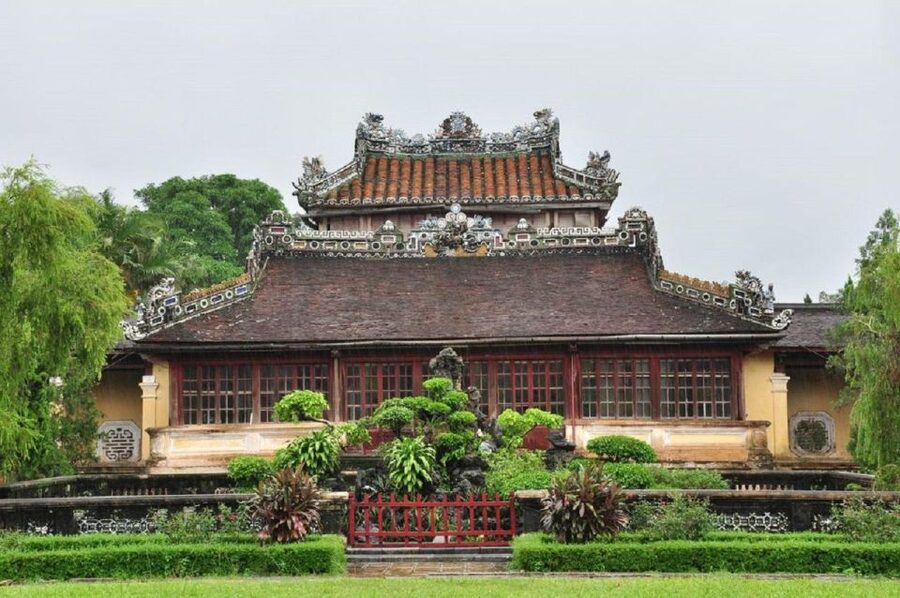
The walking tour lasts about 150 minutes, but the site itself is broad. You spend much of the visit outside, moving between courtyards, gates, temples, gardens, and palace areas.
Hue can be very hot, and this is not a sit-down activity. Guides such as Misa and Linh have adjusted explanations to keep people in the shade or allowed time to cool down. Rain is also possible. One small group continued in wet weather, and the guide kept the route moving.
An early start is the practical choice during hot months. A morning departure around 8:30 has been specifically recommended because the sun becomes harder to manage later in the day. Wear shoes suited to steady walking, bring water, and leave room for photographs.
The pace is usually relaxed rather than rushed. Guides have allowed independent time inside exhibits and paused for questions. Still, your exact experience depends on group size, weather, and how many questions you ask.
Price, tickets, and overall value
The advertised starting price is $12 per person, which is strong value for a guided walk of one of Hue’s major sights. The price is less all-inclusive than it first appears because entrance tickets, food, and drinks are separate.
Imperial City admission is listed at 200,000 Vietnamese dong per adult. Combo tickets are available at 420,000 dong for the Imperial City plus two tombs, or 530,000 dong for the Imperial City plus three tombs, valid for two days. If you already plan to visit tombs, compare the combo price with buying each ticket separately.
The walking tour offers the best value if your main goal is understanding the Citadel. You receive a local English-speaking guide, a planned route, and explanations that are difficult to get from signs alone.
The private-car option can also be good value for couples, families, or small private groups, especially when you want several sights in one day. Just remember that the driver is not a licensed guide, so you are paying for flexibility and transport rather than full interpretation.
The experience has a 4.9 rating from 937 reviews, and the strongest praise centers on guide quality, clear English, friendly conversation, and a comfortable pace. Misa is repeatedly singled out for warmth, humor, and explanations of royal symbolism. Nhi, Ha, Nhien, Linh, Duy, Hoa, Hung, and Toan are also described as helpful, engaging, and well prepared.
Who should book this Hue experience
I would choose the walking option if you have never visited the Imperial City, enjoy history, or want to understand what you are seeing instead of simply taking photographs. It also suits families, since guides have kept explanations accessible and even held children’s attention with stories about symbols and royal customs.
It is a good fit for solo visitors too. One guide tailored the route and conversation for a solo guest, adding a personal touch without making the visit feel formal.
Choose the private car if you are arranging a wider Hue day, need station or airport pickup, or prefer to set your own route. It works well when the group wants flexibility, but you should select the walking guide if detailed historical commentary is your priority.
Should you book it?
Book this experience if you want the Imperial Citadel to make sense, not just look impressive. The walking tour is short enough for a busy schedule, rich in useful context, and supported by guides who adjust their pace for questions, heat, rain, and photographs.
Choose the private car when you want several Hue sights in one outing and are comfortable paying entrance fees separately. The main limitation is clear: the driver can help you get around in English, but does not replace a trained guide at the monuments.
For most first-time visits, I would book the guided walk and add a private-car day only if you have enough time for the royal tombs and Thien Mu Pagoda.
FAQ
How long does the Hue walking tour last?
The walking tour lasts about 150 minutes, or roughly 2.5 hours. The private-car options can last from about 2.5 to 8 hours, depending on the route selected.
Where does the walking tour meet?
The guide meets you at the four bronze cannons near Ngan Gate, also called Cua Ngan, at the Citadel. The guide holds an A4 sheet with your name. There are five cannons on the opposite side, so check that you are at the correct group.
Are Imperial City entrance tickets included?
No. Imperial City admission is listed at 200,000 Vietnamese dong per adult. Combo tickets are available for the Imperial City with two or three royal tombs.
Does the private-car option include a tour guide?
No. The private-car option includes a private car and an English-speaking driver. The driver can help with communication but is not a professional licensed guide.
What attractions can I visit by private car?
You can customize the trip around the Imperial City, Thien Mu Pagoda, Minh Mang Tomb, Tu Duc Tomb, Khai Dinh Tomb, and Thuy Tien Abandoned Water Park.
Is hotel pickup available?
Pickup and drop-off are included for private-car trips from city-center hotels in Hue and Hoi An, Hue Railway Station, and Phu Bai Airport in Hue. An extra charge may apply for locations away from the city center.
Newly listed around Hue Vietnam
- Half-Day Phong Nha Cave Adventure by Dragon Boat★ 4.9 · 39 reviews
- Hoi An/Da Nang : Golden Bridge , Marble Mt & Lady Buddha★ 5.0 · 39 reviews
- From Hue/Da Nang/Hoi An: Bach Ma National Park Trekking Tour★ 4.5 · 39 reviews
- Hue City Full-Day Tour★ 4.8 · 41 reviews
- Chan May Port : to Golden Bridge/Imperial City/Hoi An Town★ 5.0 · 41 reviews
- Hue Imperial City and Forbidden City Walking Private Tour★ 4.9 · 42 reviews
- From Hue : Full-Day City Highlights Tour with Lunch★ 4.5 · 46 reviews
- Hue: Brew Egg, Salt & Coconut Coffee★ 5.0 · 47 reviews
Hue Tours, compared.

Hue to Hoi An ( Hoi An to Hue) Top Gear with Lefamily Riders Tours ( 1 way)
Read our review →
Easy Rider private tour via Hai Van pass from Hue – Da Nang – Hoi An (1Way|Loop)
Read our review →
Easy Rider From Hue Da Nang Hoi An Via Hai Van Pass With Mister T
Read our review →
Hue to Dn/Hoi An: Hai Van Pass, beaches & Mt Monkey or vice versa
Read our review →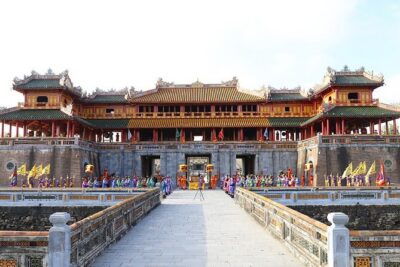
Imperial City Walk, Motorbike Tour & Private Car Options
Read our review →
Exploring Royal City with Multi Options and Dragon Boat
Read our review →
Hue city Deluxe Group Tour (Daily Tour-12 pax max)
Read our review →
Browse the lists this tour appears in