
Reviewed · HUE TOURS
Hue Imperial City and Forbidden City Walking Private Tour
Hue’s Imperial City makes far more sense with someone to explain what you are seeing. This private walk connects the Nguyen Dynasty’s 143 years of rule with the gates, palaces, gardens, theater, and temples inside the citadel, rather than leaving you to decode a large complex on your own. The restored Kien Trung Palace is a major draw, while Duyet Thi Duong gives you a glimpse of royal entertainment.
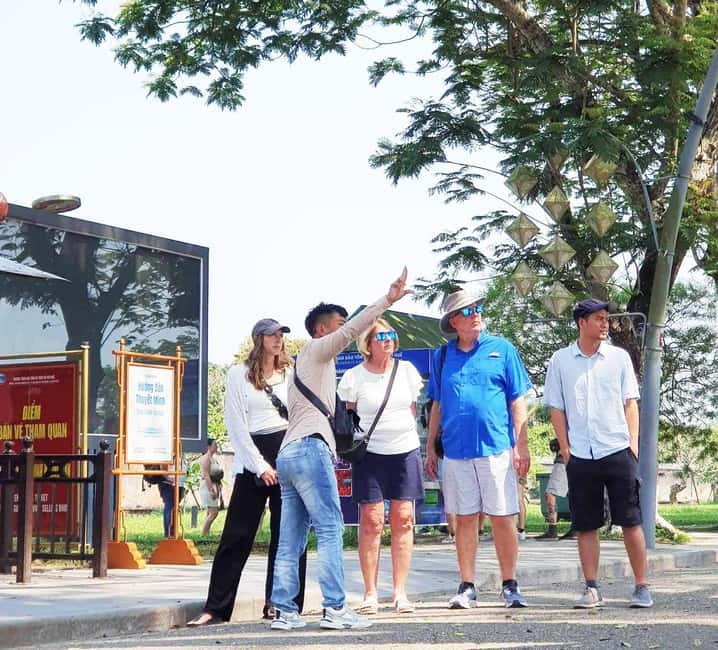
I like the small private format, which lets you ask questions and set a comfortable pace. I also like the practical start at the bronze cannons near Cua Ngan, where the guide helps you buy the entrance ticket. The main consideration is time: 150 minutes covers many sights, but it leaves little room for a slow, detailed look at every building.
Key points to know before you book
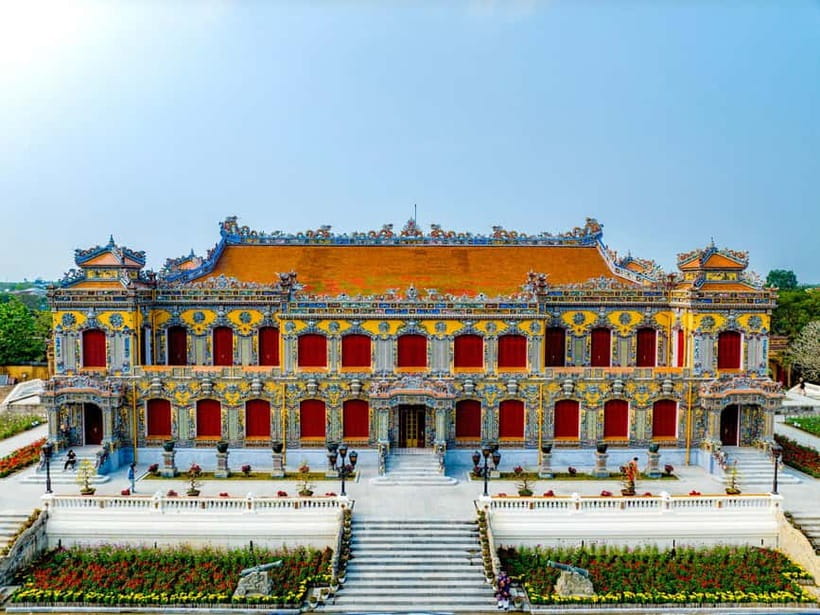
- Kien Trung Palace is newly rebuilt: The 1923 palace combines Asian and European design and was restored in 2024 after collapsing.
- You get a private English-speaking guide: Guide assignments have included Austin, Ha, Nhi, Anna, Duyen, and others praised for clear explanations and friendly help.
- The walk covers the main Imperial City sights: Expect Ngo Mon Gate, Thai Hoa Palace, the Forbidden Purple City, royal gardens, temples, urns, and historic pavilions.
- Tickets cost extra: Imperial City admission is 200,000 VND per adult, with combo tickets available for visitors also planning to see royal tombs.
- The route lasts 2 to 2.5 hours: It is a strong choice for a first look at Hue, but not a full-day archaeological tour.
- The finish is at Hien Nhan Gate: Hotel pickup and drop-off are available only with the selected option.
Why a guide matters inside Hue’s Imperial City
Hue’s citadel is not just a collection of old walls and photogenic gates. It was the political and ceremonial center of the Nguyen Dynasty, which ruled Vietnam for 143 years. Without context, you may see ornate roofs, empty courtyards, and damaged buildings. With a guide, those spaces become a story about emperors, queens, court rituals, succession, war, and the gradual decline of royal power.
This tour is built around explanation. The guide walks with you from the southern entrance toward the palace compound, pointing out how access was controlled and which buildings were meant for ceremonies, government, worship, rest, or private royal life.
The private setup is useful here. You can ask why one emperor was honored in a temple, why mandarins could not enter certain areas, or how the royal family used a particular garden. Guides assigned to this experience have included Austin, Ha, Nhi, Anna, Duyen, Long, Quan, and others. The strongest praise has focused on their ability to explain difficult material in clear language, add small stories, answer questions, and adjust the walk to the group.
English ability can vary slightly from one guide to another. One booking noted that some explanations were occasionally hard to understand, although the effort and information were appreciated. That is a fair point to keep in mind, but the overall guide score is 4.9 from 42 ratings, and the repeated strength is personal attention.
More City Tours in Hue
- Hue Customizable Tour with Imperial Citadel & Forbidden City
★ 4.9 · 937 reviews - Hue :Exploring Royal City with Multi Options and Dragon Boat
★ 5.0 · 675 reviews - Hue City Tour Full Day – Group Tour
★ 4.7 · 518 reviews
Meeting the guide at the bronze cannons
The meeting point is near Cua Ngan, close to the bronze cannons. The tour information refers to these as the Nine Holy Cannons and also identifies the meeting area as the four bronze cannons near Ngan Gate. Look for the cannons by the gate and a guide holding an A4 sheet with your name.
The cannons were cast in 1803 and are an appropriate place to begin. They are not a random landmark at the edge of the route. They belong to the early Nguyen period and help set the political and military scene before you enter the ceremonial heart of the citadel.
If you have chosen the hotel pickup option, transport is included. Otherwise, meet at the stated cannon area. The guide assists with the ticket purchase, which saves you from sorting out the entry process alone. Bring cash in Vietnamese dong. The Imperial City ticket costs 200,000 VND per adult and is not included in the tour price.
The Flag Tower and the approach to Ngo Mon Gate
The Flag Tower rises at the center of the citadel’s southern wall. Known as Ky Dai Hue, it was the flag-bearing site for the royal court and remains one of the first major sights you encounter.
Your guide usually spends about 10 minutes here. That is enough for a short explanation and photographs, but not a long architectural study. The tower is best understood as part of the approach to the palace zone, where the scale of the walls and open space begin to show how carefully the Nguyen court controlled movement.
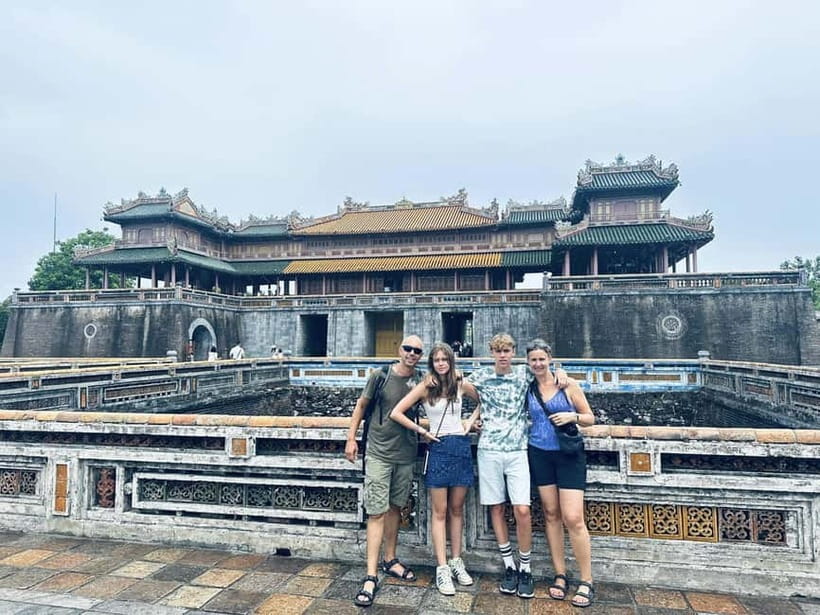
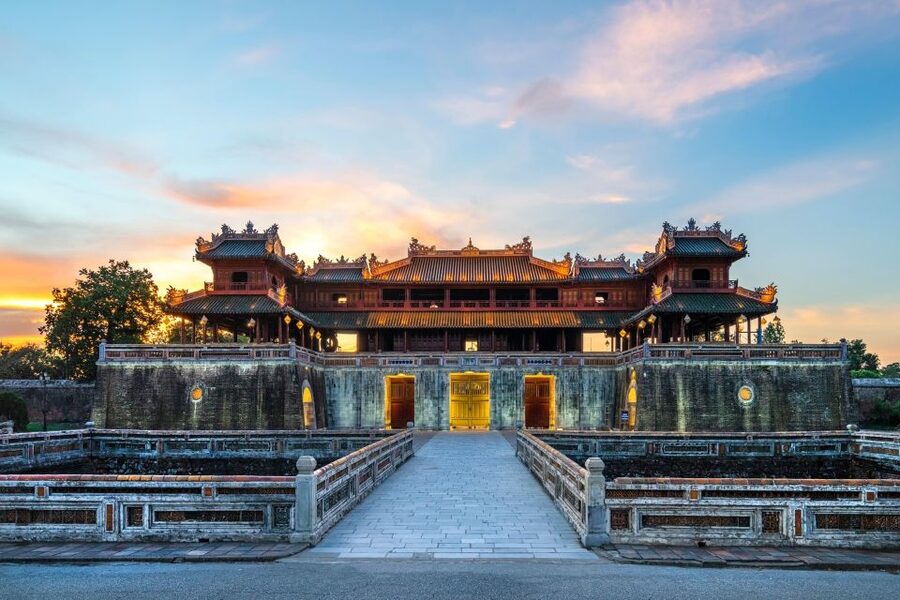
From here, you walk toward Cua Ngo Mon, or Ngo Mon Gate. Built in 1833, this was the principal ceremonial entrance reserved for the king and for receiving envoys. The gate was not an ordinary doorway. Its position and design expressed rank, authority, and access to the royal compound.
Above it is Ngu Phung Pavilion, a striking timber structure made with ironwood and supported by 100 pillars. The tour allows about 10 minutes at the gate and pavilion. That is a quick stop, so use it well: ask about the separate levels, look up at the roof structure, and take your photographs before moving through.
Thai Hoa Palace and the Forbidden Purple City
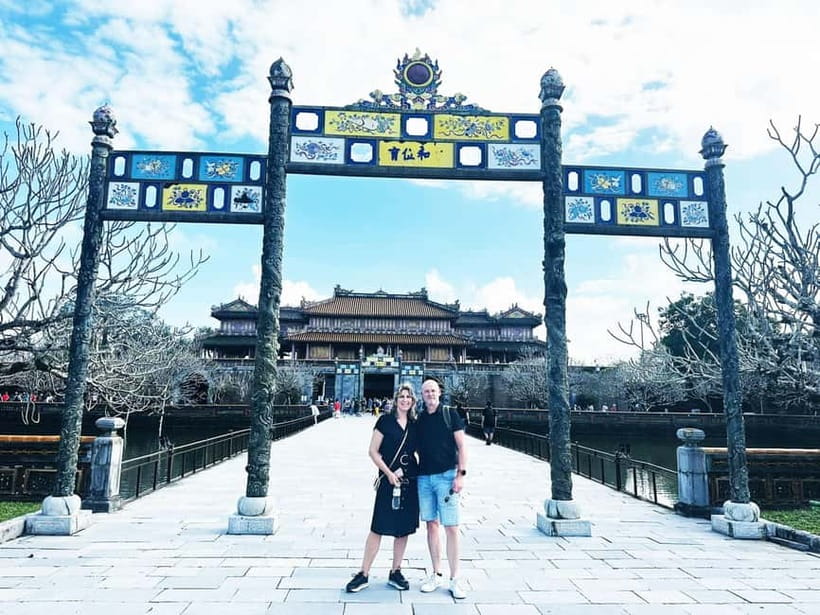
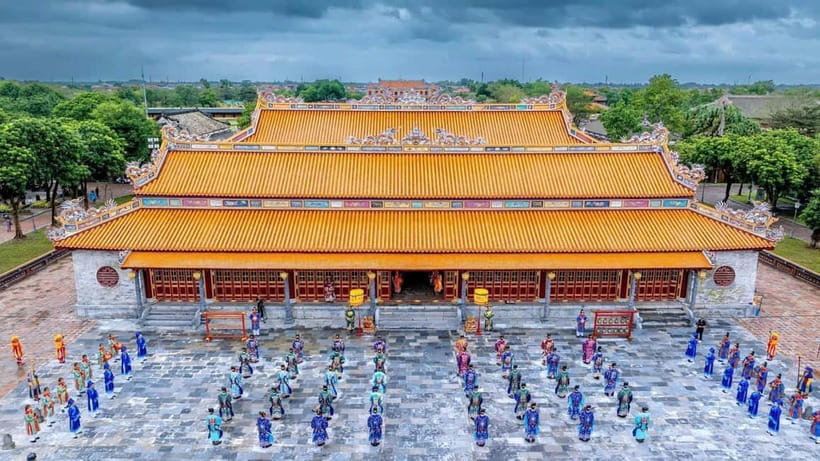
Thai Hoa Palace is the ceremonial centerpiece of the Imperial City. It was the coronation site of 13 Nguyen kings, which gives the building more weight than its elegant exterior alone suggests.
You spend around 15 minutes here. The guide explains how the palace functioned during major court ceremonies and why its position inside the complex mattered. This is one of the places where a guide adds real value, since the building’s importance is tied to ritual and political order rather than visual detail alone.
Beyond the palace is the Forbidden Purple City, reserved for the emperor and royal family. Mandarins and ordinary citizens were not permitted to come close. The name can sound mysterious, but the useful point is its strict separation from the public and ceremonial parts of the citadel.
The Forbidden Purple City suffered heavy damage over time, so you will not find every structure intact. That loss is part of the story. The guide can help you picture the former royal compound and explain how life inside it differed from the formal world of Thai Hoa Palace.
The itinerary lists a general Imperial City visit as well as the individual palace stops. Expect these sections to blend into one continuous walk rather than separate attractions with long breaks between them.
More Walking Tours in Hue
- Hue Imperial Ancient City Walking Tour
★ 4.8 · 308 reviews - Hue Imperial City Walking Tour: Citadel & Forbidden City
★ 4.8 · 245 reviews - Eat like a local with a local – Walking Tour
★ 4.9 · 57 reviews - Hue: Imperial City Walk, Motorbike Tour & Private Car Options
★ 5.0 · 732 reviews
Duyet Thi Duong, the oldest preserved royal theater
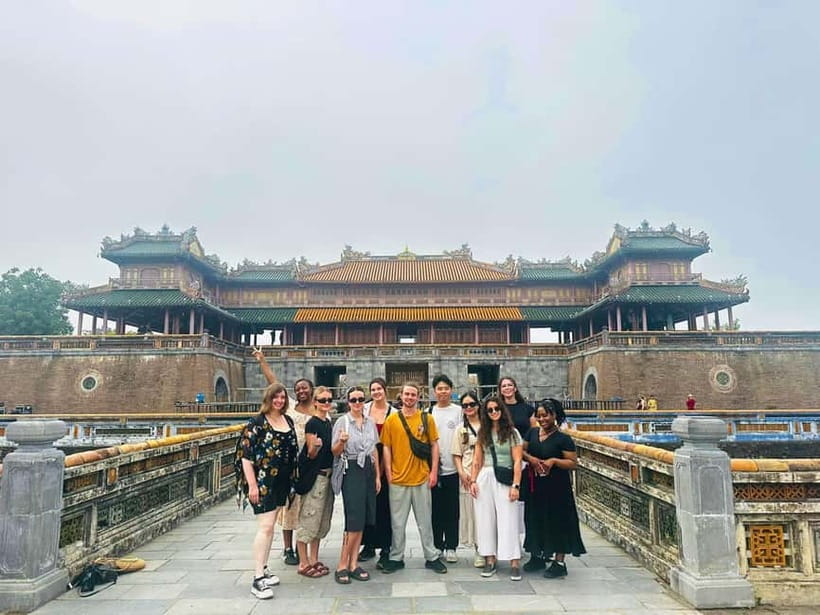
Duyet Thi Duong is one of four theaters built during the Nguyen period and is the oldest preserved theater from that era. This stop gives the tour a welcome change of mood.
Palaces and temples can make royal life seem solemn and restricted. A theater reminds you that the court also made room for music, drama, ceremony, and entertainment. The guide explains its role and points out details that are easy to pass without context.
The scheduled visit is about 10 minutes. You will have time for photographs and a short talk, but this is not a performance visit. The tour focuses on the building and its place in court life.
Thiệu Phương Garden and Thai Binh Pavilion
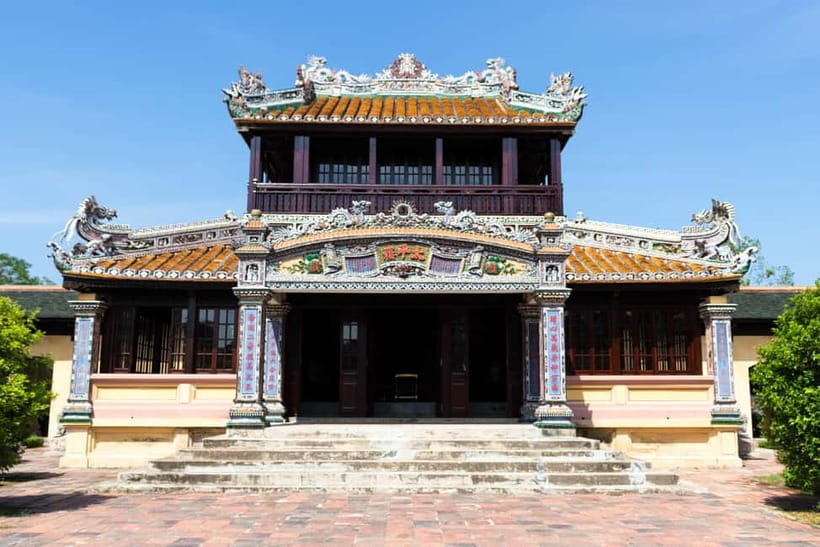
Thiệu Phương Garden was built in 1828 and is one of the classic royal gardens associated with the Nguyen court. It offers a softer view of palace life, with designed space intended for quiet enjoyment rather than public ceremony.
I particularly like this part of the route because it breaks up the sequence of gates and formal halls. You get to consider what the emperor and court did during periods of rest, and how garden design could express refinement and status.
You spend about 10 minutes here, followed by roughly 15 minutes at Thai Binh Pavilion. Built between 1919 and 1921, Thai Binh Pavilion served as a place for the king to rest and relax.
The two stops work well together. Thiệu Phương shows the garden setting, while Thai Binh explains how royal leisure was organized. The short timing means you should not expect an unhurried garden visit. Still, these are useful stops if you want more than military and ceremonial history.
Kien Trung Palace and the story of restoration
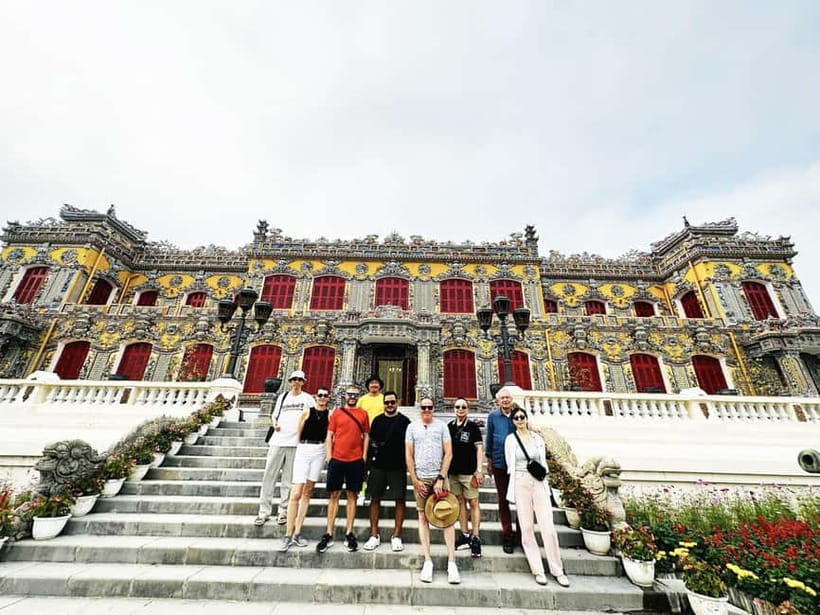
Kien Trung Palace is one of the most interesting stops on this walk because it connects imperial ambition with modern restoration. Built in 1923, it combines Asian and European architectural features, reflecting the changing world of the late Nguyen court.
The palace completely collapsed and was restored in 2024. That makes the building visually impressive, but it also raises a useful question: how do you understand a rebuilt palace inside a damaged historic complex?
The guide can help explain what the palace represented and why its mixed design matters. You will have about 15 minutes here for a guided visit and photographs. This is likely to be one of the tour’s most popular photo stops, but try not to treat it as only a pretty facade. Its design belongs to a late period when Vietnamese royalty operated in a very different political setting.
The restoration also gives you a chance to compare new work with older surviving structures. Some visitors prefer ruins because they show age more plainly. Others appreciate seeing the palace form made legible again. If you fall into the first group, ask the guide about the building’s collapse and rebuilding rather than judging it only by appearance.
Dien Tho Palace and the women of the royal court
Dien Tho Palace was the residence of the Queen Mother. Its scale, carved details, and restrained style offer a different view of the court from the emperor-focused buildings near Thai Hoa Palace.
The tour gives this stop about 10 minutes. You can look for the fine decorative work and ask how the Queen Mother’s residence related to the emperor’s compound. The building helps widen the story beyond kings and coronations by showing where an important female member of the royal family lived and received people.
This is another stop where a short guided explanation matters. The architecture may seem quiet compared with Ngo Mon Gate or Kien Trung Palace, but its role was central to the internal structure of the royal household.
Temples, dynastic urns, and Hien Lam Pavilion
The later part of the walk turns toward remembrance and royal worship. Hung To Mieu is included as a temple stop, followed by the Nine Dynastic Urns and Hien Lam Pavilion.
The temple area is connected to ancestor worship and the honoring of Nguyen rulers. The Mieu complex is dedicated to 10 Nguyen kings, showing how the dynasty presented its own past and chose which rulers to honor.
The Nine Dynastic Urns were commissioned by Emperor Minh Mang in 1835. Together, the nine bronze urns carry 162 cast and carved images. These are not simple decorative objects. Their images represent the natural world, symbols of power, and the dynasty’s view of the realm.
Allow about 10 minutes at the urns. The guide can point out the imagery, but the pace is too short for a close reading of every design. If bronze work and symbolism interest you, this is a place where your own questions will improve the visit.
Hien Lam Pavilion was built from 1821 to 1822 and is described as a place where emperors had epiphanies. You spend around 10 minutes here before the walk ends at Cua Hien Nhon, or Hien Nhan Gate.
The final group of sights gives the tour a strong ending. You move from living quarters and leisure spaces to the dynasty’s memory, worship, and public image.
What $23 gets you, and what it does not
At $23 per person, the tour offers good value if you want a private guide rather than a self-guided walk. The price includes an English-speaking guide, bottled water, and a 2.5-hour guided visit. Hotel pickup and drop-off are included only when you choose that option.
The Imperial City entrance ticket is extra at 200,000 VND per adult. That matters because the advertised tour price is not the complete cost of entry. Your guide helps you buy the ticket, and cash in Vietnamese dong is recommended to reduce delays.
Combo tickets may make sense if Hue is part of a longer sightseeing plan. The listed options are 420,000 VND per adult for the Imperial City plus two royal tombs, or 530,000 VND for the Imperial City plus three tombs. These tickets are valid for two days, so they can offer better value than buying separate admissions if you already plan to visit the tombs.
The tour is not designed around meals or refreshments. Food and drinks are not included, although bottled water is provided. Plan to eat before or after the walk.
Pace, weather, and practical comfort
The route is a walking tour lasting between two and two and a half hours. It includes many stops, but the listed times add up to a brisk visit. You will see the principal sights, hear the main story, and have regular photo opportunities. You will not have much spare time to linger inside every courtyard.
Start time depends on your selected arrangement and requirements. An early start can be useful if you want a quieter first look. One guide, Anna, agreed to begin early so the group could enter before the busiest period. That kind of timing request is worth asking about when you book, but it should be confirmed rather than assumed.
Hue weather can change the feel of the experience. In heavy rain, guide Anna arrived with a poncho and helmet for a guest, showing the sort of practical care that can make a wet walk manageable. Still, bring suitable footwear and be ready for outdoor walking. The tour goes ahead as a walking experience, not as a museum-only visit.
Communication before the tour is another strength. Austin contacted one group before the meeting time, and last-minute communication with Ha worked well for another booking. Your guide holds an A4 page with your name, but you should still check the meeting instructions carefully because the cannon area and gate names can look similar.
Who should choose this Hue tour
I would choose this experience if you have limited time in Hue and want the Imperial City explained in one focused visit. It is also a good match for couples, families, and small groups who prefer to ask questions without keeping up with a large party.
History fans will appreciate the links between the 13 Nguyen kings, the Queen Mother’s residence, court theater, ancestor temples, and the dynasty’s bronze urns. Architecture fans will be especially interested in Ngo Mon Gate, Ngu Phung Pavilion, Thai Hoa Palace, and the restored Kien Trung Palace.
This may not suit you if you want to spend an entire day wandering slowly through the citadel. The private format helps with flexibility, but the set 150-minute duration still places a limit on how long you can study each building.
Guide quality is a major part of the value. Austin, Ha, Nhi, Anna, Duyen, Long, Quan, and other assigned guides have been praised for warmth, clear explanations, humor, and help beyond the route. Several also offered practical advice about restaurants, local food, drivers, and further sightseeing. Those extras are useful, but the main reason to book is the interpretation inside the Imperial City.
Should you book it?
Book this tour if you want the main Imperial City sights in a well-paced private walk and value a guide who can explain the Nguyen court in plain English. The restored Kien Trung Palace, the oldest preserved royal theater, and the bronze urns give the route more range than a simple gate-and-palace visit.
Skip it if you plan to spend most of the day inside the citadel on your own or if you dislike a brisk schedule. Remember to add the 200,000 VND entrance ticket per adult and prepare cash.
For a first visit, $23 per person is a sensible price for private attention, historical context, and help navigating a large complex. I would ask for an early start if available, confirm the meeting point, and come ready to walk.
FAQ
How long does the Hue Imperial City tour last?
The tour lasts between 2 and 2.5 hours, with the listed duration given as 150 minutes.
Is this a private tour?
Yes. The tour is for a private group with an English-speaking guide.
Is the Imperial City entrance ticket included?
No. Admission costs 200,000 VND per adult and must be paid separately.
Can the guide help me buy the entrance ticket?
Yes. The guide meets you near the bronze cannons and assists with purchasing the Imperial City ticket.
Where is the meeting point?
The guide waits near the four bronze cannons by Ngan Gate, also called Cua Ngan, with an A4 paper displaying your name.
Is hotel pickup included?
Hotel pickup and drop-off are included only if you select the option that provides them.
What language is the tour conducted in?
The live tour guide speaks English.
Which major sites are included?
The route includes the Flag Tower, Ngo Mon Gate, Ngu Phung Pavilion, Thai Hoa Palace, the Forbidden Purple City, Duyet Thi Duong Royal Theater, Thiệu Phương Garden, Thai Binh Pavilion, Kien Trung Palace, Dien Tho Palace, Hung To Mieu, the Nine Dynastic Urns, and Hien Lam Pavilion.
Are combo tickets available for other Hue sights?
Yes. A 420,000 VND adult combo covers the Imperial City and two tombs, while a 530,000 VND adult combo covers the Imperial City and three tombs. The combo tickets are valid for two days.
More Walking Tours in Hue Vietnam
- Private Street Food Evening Walking Tour in Ho Chi Minh City
★ 5.0 · 3,175 reviews - [HOT] Hanoi Old Quarter Walking Street Food – Small Group Tour
★ 5.0 · 2,163 reviews - Super Niche Walking Street Food Tour in Ho Chi Minh City
★ 5.0 · 1,636 reviews - Private Walking Tour of Hanoi City
★ 5.0 · 1,251 reviews
Newly listed around Hue Vietnam
- Half-Day Phong Nha Cave Adventure by Dragon Boat★ 4.9 · 39 reviews
- Hoi An/Da Nang : Golden Bridge , Marble Mt & Lady Buddha★ 5.0 · 39 reviews
- From Hue/Da Nang/Hoi An: Bach Ma National Park Trekking Tour★ 4.5 · 39 reviews
- Hue City Full-Day Tour★ 4.8 · 41 reviews
- Chan May Port : to Golden Bridge/Imperial City/Hoi An Town★ 5.0 · 41 reviews
- From Hue : Full-Day City Highlights Tour with Lunch★ 4.5 · 46 reviews
- Hue: Brew Egg, Salt & Coconut Coffee★ 5.0 · 47 reviews
- Hue City: Cyclo, Market Tour & Cooking Class at Madam Thu★ 5.0 · 48 reviews
Hue Tours, compared.
Hue to Hoi An ( Hoi An to Hue) Top Gear with Lefamily Riders Tours ( 1 way)
Read our review →
Easy Rider private tour via Hai Van pass from Hue – Da Nang – Hoi An (1Way|Loop)
Read our review →
Hue Customizable Tour with Imperial Citadel & Forbidden City
Read our review →
Easy Rider From Hue Da Nang Hoi An Via Hai Van Pass With Mister T
Read our review →
Hue to Dn/Hoi An: Hai Van Pass, beaches & Mt Monkey or vice versa
Read our review →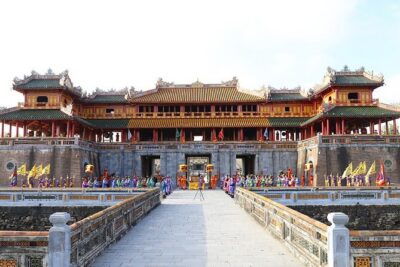
Imperial City Walk, Motorbike Tour & Private Car Options
Read our review →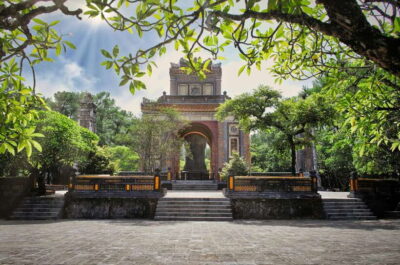
Exploring Royal City with Multi Options and Dragon Boat
Read our review →
Hue city Deluxe Group Tour (Daily Tour-12 pax max)
Read our review →Browse the lists this tour appears in