
Reviewed · DA NANG TOURS
5 traditional dishes Da Nang cooking class with market trip
The best part of this Da Nang cooking class happens before you reach the stove. At Chợ Bắc Mỹ An, you shop for ingredients with your instructor, learn what local produce is used for, and see how ordinary market goods become a five-dish Central Vietnamese meal. It gives the cooking a useful sense of place.
I like the well-rounded menu, which moves from spicy noodle soup to crisp banh xeo, fresh rolls, salad, and dessert. I also like that you eat what you prepare, receive a cookbook and certificate, and can request vegetarian adjustments. The main thing to consider is group size: the class can accept up to 30 people, and some cooking or plating may be shared rather than fully individual.
Key points
- Chợ Bắc Mỹ An visit: Shop for the ingredients and learn how local produce fits each recipe.
- Five Central Vietnamese dishes: Prepare Bun Bo Hue, banh xeo, tam huu fresh rolls, young jackfruit salad, and Da Nang avocado ice cream.
- Flexible menu: Vegetarian versions can be arranged to suit dietary needs.
- Friendly instruction: Teachers including Blue, Bora, Chi, and Jenny have led classes with patient demonstrations and good English.
- Meal included: Sit down to eat the food you have made, with fruit, rice vodka, and conversation.
- Useful take-home items: A recipe book and certificate help extend the class beyond Da Nang.
Why the market visit makes this class worthwhile
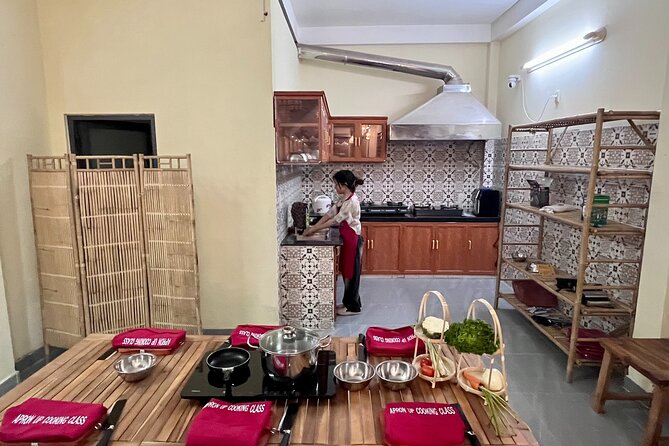
Cooking schools often begin with an apron and a chopping board. This one starts at a neighborhood market, which gives you a better introduction to Central Vietnamese food.
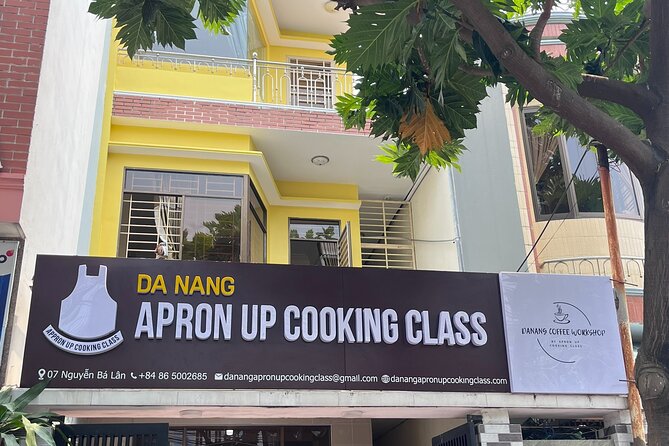
The meeting point is at 07 Nguyễn Bá Lân Street in Bắc Mỹ An, Ngũ Hành Sơn. You meet there about 10 minutes before the start, then walk to nearby Chợ Bắc Mỹ An. The market stop is not just a quick shopping errand. Your instructor helps identify the products needed for the menu and explains the role of each ingredient.
That matters because Vietnamese cooking depends on balance. A bowl of Bun Bo Hue is not simply noodles and beef. A banh xeo is not just a fried pancake. The market helps connect the dish to the fresh herbs, vegetables, wrappers, fruit, and other products that give Central Vietnamese food its character.
You also get a look at daily life in Da Nang without setting aside a separate market tour. Bring comfortable shoes and expect the market to be a sensory part of the morning or afternoon, depending on your selected start time. The supplied schedule does not list exact start times, so check your booking confirmation carefully.
More Cooking Classes in Da Nang
- 5 Dishes Cooking Class with Market Trip in Da Nang
★ 5.0 · 466 reviews - Da Nang Authentic Home Cooking Class
★ 5.0 · 354 reviews - Da Nang Cooking Class with Coffee Tasting and Market Visit
★ 5.0 · 310 reviews
Chợ Bắc Mỹ An: shopping for the five-dish menu
Chợ Bắc Mỹ An is the only named stop, but it is an important one. Your group shops for the ingredients used back at the kitchen, giving you a clearer idea of how a local cook approaches a meal.
The market visit should appeal to you if you like asking practical food questions. You can learn about products connected to the class menu and hear the stories behind the dishes. It also offers an easy way to take photographs, though you should stay with the group and follow your guide’s lead around the market.
The stop is useful for families, too. Two children, aged 10 and 13, were specifically described as receiving patient help from the instructors. That suggests the class is not aimed only at confident adult cooks. Children can take part in the market trip and cooking steps, though adults should still expect an active kitchen setting.
One point to keep in mind is that the size of the group can vary. The maximum is 30 people, while some sessions have been much smaller. A small class allows more direct help. A full session may feel less personal, especially when several people need to work at once.
Back at the kitchen: five dishes from Central Vietnam
After the market, you return to the cooking school at the original meeting point. Cooking tools are provided, so you do not need to bring equipment. The class lasts about four hours, including the market visit, cooking, and meal.
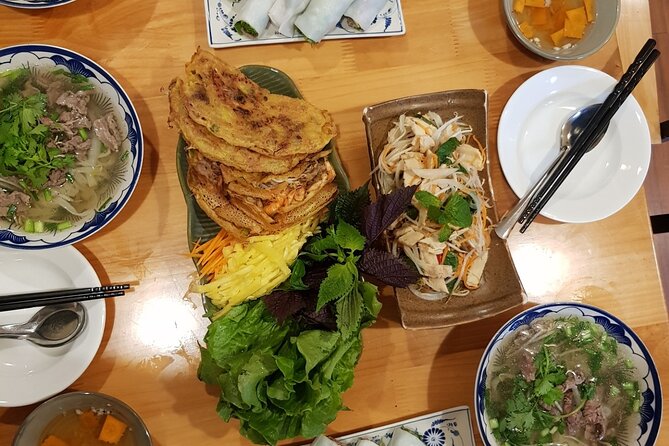
The menu is designed as a small banquet rather than one single recipe. That is a smart choice for a first cooking class in Da Nang because you see several different methods, textures, and flavor combinations.
Bun Bo Hue
Bun Bo Hue is the most substantial dish on the menu. This Central Vietnamese noodle soup is known for a strong, spicy broth and a satisfying meal-sized portion.
The class gives you a way to understand the basic process rather than simply ordering a bowl at a restaurant. You can see how the ingredients come together and how the soup fits into the wider food traditions of Central Vietnam.
There is one practical limitation. The soup may be prepared as a group recipe, so you may not handle every step alone. If you want a fully individual cooking project, ask how the soup will be divided before the class begins.
More Markets in Da Nang
- Guided Tour to Marble Mountains & Hoi An Walking Tour , Night Market, Boat Ride
★ 5.0 · 218 reviews - Hoi An Night Market with Hoi an walking Tour , Colourful Lanterns, Boat Ride
★ 5.0 · 142 reviews - DaNang Farm-to-Table Cooking Class with Market and Coffee Tasting
★ 5.0 · 131 reviews - Market Tour, Basket Boat Ride & Cooking Class by Hangcoconut
★ 4.8 · 95 reviews
Banh Xeo
Banh xeo is the dish most likely to keep you busy at the pan. It is a crisp Vietnamese pancake, and getting the right browned edge takes attention.
This is a good class dish because technique matters as much as ingredients. You learn how the batter is handled and how to aim for a thin, crisp result rather than a soft, heavy pancake. It also gives you a meal that feels distinctly Vietnamese but is still practical to repeat at home.
The best tip is to watch the demonstration closely before you start. The timing of the pan and the amount of batter can make a big difference. One family praised the teachers for helping them understand how to make a crispy, perfectly browned pancake, which is exactly the sort of small lesson that makes a cooking class useful.
Tam Huu fresh roll
Tam huu fresh rolls add a lighter, cooler element to the meal. Unlike the hot pancake and soup, this dish focuses on wrapping, arranging, and balancing fresh ingredients.
Fresh rolls can look simple, but the wrapper takes a little practice. Roll too loosely and it falls apart. Add too much filling and it becomes hard to close. This is one place where personal help from the instructor makes a difference.
Some participants have found the roll tricky and less flavorful than the other dishes. You may want to treat it as a technique lesson rather than the star of the meal. The class menu offers plenty of variety, so one less successful dish should not define the whole experience.
Young jackfruit salad
Young jackfruit salad brings a different texture and shows you an ingredient that may be unfamiliar. It gives the menu a local touch beyond the better-known noodles, pancakes, and rolls.
The salad also helps break up the richer dishes. That balance is one of the strengths of the menu. You are not spending four hours preparing five versions of fried food. The meal includes soup, cooked batter, fresh wrapping, salad, and dessert.
Da Nang avocado ice cream
The final dish is Da Nang avocado ice cream. It is an unusual ending for a cooking class and gives you a chance to see how a familiar fruit can be used in a local-style sweet dish.
If you choose the vegetarian option, the menu can be adjusted. The description says the class is flexible enough to meet dietary requirements, but you should state your needs when booking rather than waiting until the market visit.
How the teaching works in a mixed group
The instruction is built around demonstrations and hands-on preparation. Teachers show the methods, guide you through the recipes, and help as you cook.
Blue, Bora, Chi, and Jenny are among the instructors associated with the classes. Their teaching styles have been described as friendly, patient, humorous, and clear, with particular care given to children and beginners. The language skills of the teaching team also make the class suitable for international visitors.
You do not need to be a skilled cook. The recipes are approachable, and the class is structured so you can follow along even if Vietnamese food is new to you. A patient instructor can explain how to handle wrappers, batter, salad ingredients, and soup preparation without assuming that you already know the basics.
The class may be less satisfying if you want a private chef-led lesson. The maximum group size is 30, and some parts of the meal may be made or plated together. One practical criticism is that not every participant gets to prepare and plate every dish independently.
That trade-off helps keep the price down. It also makes the class social. You can meet people from other countries while cooking and share the final meal together. If you prefer individual control, ask whether a smaller session is available.
Sitting down to eat what you cooked
The meal is the reward at the end. You sit down at the kitchen and eat the food prepared during the class, with fruit, rice vodka, and time to chat with your instructor about local life.
This shared meal gives the class a pleasant finish. You are not rushed out after the last demonstration, and you get to see how the separate dishes work together. The menu is broad enough to feel like a proper Vietnamese spread.
The food quality will depend partly on your group’s cooking. That is part of the point. A cooking class is not a restaurant meal with guaranteed identical results. You may produce a superb banh xeo and a less tidy roll. The instructor’s guidance helps, but the experience remains hands-on.
You should also note that the included food is described as lunch and dinner in the inclusions. The class itself lasts about four hours, but the exact meal timing depends on the session you select. If you have strict dietary needs, confirm the adjustment in advance.
Price, timing, and what you take home
At $39 per person, this is a fair value if you want more than a meal. The price covers the market visit, cooking tools, instruction, the food you prepare, and a cookbook and certificate.
The cookbook is especially useful. It lets you try the recipes after returning home instead of leaving the class with only photographs. The certificate is a small extra, but families and first-time cooking students may enjoy having it as a record of the activity.
Four hours is long enough to cover the market, five dishes, and the shared meal without turning the class into a full-day commitment. It also means you should not schedule a tight attraction immediately afterward. The activity ends back at 07 Nguyễn Bá Lân Street.
The meeting point is near public transportation, and mobile tickets are accepted. Confirmation is provided at booking. Service animals are allowed.
You can cancel for a full refund if you do so at least 24 hours before the start time. Changes or cancellations inside that 24-hour window are not accepted for a refund. The minimum number of participants must also be met, and if the provider cancels for that reason, you will be offered another option or a full refund.
Who should book this Da Nang cooking class
I would choose this class if you want to connect food with ordinary life in Da Nang. The market visit gives the activity more substance than a kitchen lesson alone, while the five-dish menu gives you a broad sample of Central Vietnamese cooking.
It suits:
- First-time visitors who want a practical introduction to local food
- Couples looking for a shared activity
- Families with children who can follow kitchen instructions
- Beginners who want clear demonstrations
- Vegetarian diners who arrange their needs ahead of time
- Home cooks who want recipes to use after the trip
You may want another format if you require a private class, need every dish prepared individually, or dislike shared plating. A full group can also mean less one-to-one help, so ask about group size if personal instruction is your top priority.
Should you book Apron Up Cooking Class?
Yes, if you value the full food story: market shopping, preparation, cooking, and eating. The strongest parts are the local market stop, the varied five-dish menu, the friendly teaching style, and the recipe book you take home.
Book with realistic expectations. This is a join-in class, not a private kitchen lesson, and the group may be large. Some dishes, especially the soup and shared plating, may involve teamwork rather than a separate finished plate for each person.
For $39, the package offers solid value. You get a four-hour activity, a meal, equipment, market guidance, and a useful look at Central Vietnamese cooking. If you want a social and hands-on food experience in Da Nang, this is an easy choice to add to your plans.
FAQ
Where does the cooking class begin?
Meet at 07 Nguyễn Bá Lân, Bắc Mỹ An, Ngũ Hành Sơn, Da Nang 550000, Vietnam, about 10 minutes before the start time.
Which market does the class visit?
The class visits Chợ Bắc Mỹ An to learn about local produce and buy ingredients for the recipes.
How long does the activity last?
The activity lasts approximately four hours, including the market visit, cooking, and meal.
Which dishes will I cook?
The menu includes Bun Bo Hue, banh xeo, tam huu fresh rolls, young jackfruit salad, and Da Nang avocado ice cream.
Is there a vegetarian option?
Yes. The menu can be adjusted with a vegetarian version, and the class is described as flexible for dietary requirements.
Is food included?
Yes. You eat the meal made during the class, and the inclusions list lunch and dinner. Fruit and rice vodka are also provided.
Is cooking equipment provided?
Yes. Cooking tools are included.
How many people can join the class?
The activity has a maximum capacity of 30 people. The actual group size can vary.
Can I cancel for a refund?
Yes. You can receive a full refund if you cancel at least 24 hours before the experience start time. Cancellations or changes made within 24 hours are not refunded or accepted.
More Shopping Trips in Da Nang
- Hanoi Cooking Class: Culture, Local Market & Meaning CSR Impact
★ 5.0 · 5,147 reviews - 5 Traditional Dishes Hanoi Cooking Class with Market Trip
★ 5.0 · 4,890 reviews - Cooking Class Hoi An:Local Market, Basket Boat, Fishing & Cooking
★ 5.0 · 3,660 reviews - Hoi An Cooking Class(Market,BasketBoat Crabfishing&Cooking Class)
★ 5.0 · 3,386 reviews
More Shopping Tours in Da Nang
- Marble Mountain – Hoi An Colour Lanterns & Night Market from DN
★ 5.0 · 67 reviews - Home Cooking Class: Market, Garden and cooking 4 dishes
★ 5.0 · 61 reviews - Cook 5 Dishes Authentic Vietnam Food and Market Adventure
★ 5.0 · 56 reviews
Newly listed around Da Nang
- Danang City Full Day Tours★ 5.0 · 39 reviews
- Guided Daily City Tours in Danang★ 5.0 · 40 reviews
- Hoi An/DaNang : Private Trip to Marble Mountain & Lady Buddha★ 5.0 · 42 reviews
- Surf Lessons★ 5.0 · 42 reviews
- Hoi An / Da Nang to Ba Na Hills Day Trip with Golden Bridge★ 4.7 · 42 reviews
- Explore Hoi An and Da Nang by private tour with local guide★ 5.0 · 43 reviews
- Ba Na Hills and Golden Bridge Full Day Tour Small Group★ 5.0 · 44 reviews
- Da Nang City Tour Motorbike/Scooter & Sightseeing By Lady Rider★ 5.0 · 44 reviews
Da Nang Tours, compared.

Full Day Golden Bridge and Ba Na Hills Small Group Tour
Read our review →
Morning Small group to Marble Mountains – Am Phu Cave – Monkey Mountain
Read our review →
Da Nang & Hoi An: Food, Sightseeing, Culture & Hidden Gems
Read our review →
Marble Mountains – Am Phu Cave – Monkey Mountain Sunset tour
Read our review →
Marble Mountains – Hoi An Ancient Town Sunset Daily Ingroup Tour
Read our review →
Lady Buddha, Marble Mountain & Am Phu Caves Tour
Read our review →Browse the lists this tour appears in